-
1. Where is Mount Kailash and how to get to Kailash?
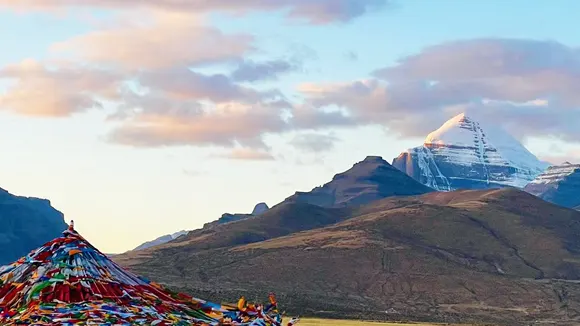
Mount Kailash and Lake Mansarovar are both located in the Ngari Prefecture of Tibet Autonomous Region of China, near the border with India and Nepal. Mount Kailash lies in the Gangdise Mountains of the Transhimalaya, in the western part of the Tibetan Plateau. It’s about 1,200km from Lhasa and 840km from Kathmandu. 47.6 kilometers to the south of Mount Kailash lies the holy Lake Mansarovar.
To get to Mount Kailash, travelers typically start their journey from either Lhasa, the capital of Tibet, Kathmandu, the capital of Nepal, Xinjiang, or Delhi, India.
From Lhasa, travelers usually choose to drive along the southern route to Mount Kailash via Shigatse, Lhatse, Saga and Paryang, before reaching Darchen, the small village at the foot of Mount Kailash. Travelers can visit natural and cultural wonders along the well-paved road, with the first part along G318 Sichuan-Tibet Highway and the last part along G219 Xinjiang-Tibet Highway. An alternative is to fly to Ngari Gunsa Airport in Shiquanhe Town and then drive 248km to Darchen.
From Kathmandu, travelers have mainly three ways to get to Kailash Mansarovar region. The first option is to fly from Kathmandu to Lhasa, and then follow the overland route from Lhasa to Mount Kailash. This route is suitable for tourists who want to enjoy the best of both Tibet and Nepal. The second choice is to take an overland trip from Kathmandu to Mount Kailash, by crossing the border of Nepal and China. You will drive from Kathmandu to the Nepal border at Rasuwagadhi, and then cross Gyirong Port, the border at Tibetan side. After entering Tibet, there is a long drive from Gyirong to Darchen. The third one is to take a helicopter. A chartered helicopter largely reduces the stress of long drives. The tourists will be travelling from Kathmandu to Simikot by scheduled flight and then from Simikot to China border by a chartered helicopter. Lake Mansarovar and Mount Kailash will remain only some short drive away from here.
From Delhi, travelers can get to Kailash via Nepal. This route is quite easy as Indian nationals can get into Nepal with no need to apply for a visa or permit. After reaching Kathmandu, you can travel overland from Kathmandu to Mt. Kailash via Gyirong or fly to Lhasa first and then go to Kailash.
From Xinjiang, tourists can drive from Kashgar in the Uyghur Autonomous Prefecture to Shiquanhe Town in Ngari Prefecture along the G219 Highway. It’s about 1,300km by road with the landscapes changing from deserts and cliffs to grasslands and snow mountains. An alternative is to take a flight from Kashgar Laining International Airport to Ngari Gunsa Aiport, 45km southwest of Shiquanhe Town. After reaching Shiquanhe, you’re close to Mt. Kailash. It’s only about 248km from Shiquanhe Town to Darchen.
-
2. What travel documents are required for Kailash tour?
First, you need to obtain a Chinese Visa. With your Chinese visa and a valid passport, you can apply for the Tibet Travel Permit, which is the prerequisite for your entry into Tibet.
Notice: If you travel overland from Kathmandu to Tibet, do not apply for a Chinese Visa because you’ll need a Chinese Group Visa. Your Chinese Visa will automatically expire when you apply for a Chinese Group Visa.
As Mount Kailash is situated in the remote western part of the Tibet Autonomous Region, additional travel documents are required for your visit, such as the Aliens’ Travel Permit and the Military Area Entry Permit.
If you plan to travel from Tibet to Nepal, you need to apply for a Nepal visa at the border. A 15-day Nepal visa costs 30 USD in cash. Please prepare the visa fee in advance.
All necessary documents for visiting Mount Kailash (except for your Chinese Visa) are included in our packages. We will apply for your Tibet Travel Permit and other permits to ensure a smooth and worry-free Mount Kailash tour.
-
3. How to apply for Chinese Group Visa in Nepal?
First, confirm your Tibet tour.
Discuss your Tibet trip itinerary with our travel consultant. Then, sign the tour contract by paying the deposit. After booking your trip, provide the copy or photocopy of your passport to us.
Secondly, submit the Tibet Travel Permit and Invitation Letter application.
We will gather your travel information and submit your Tibet Permit application to Tibet Tourism Bureau (TTB). Normally, it takes 8-9 working days to get your Tibet Travel Permit. Meanwhile, we’ll apply for your Official Group Authorization Visa Invitation Letter, which is needed for applying for your Chinese Group Visa. It usually takes 8 working days to arrange your Visa Invitation Letter and we’ll send it to the Chinese Embassy in Kathmandu.
Thirdly, arrive in Kathmandu and give your original passport to our staff.
Please arrive in Kathmandu at least 4 days earlier before you enter Tibet and give your original passport, personal photo, visa fee, and service fee to our staff in Kathmandu and fill out the application form. You also need to visit the Chinese Embassy in Kathmandu to input your fingerprint.
Lastly, get you China Group Visa.
Your China Group Visa will be given to you in person by our staff in your hotel in Kathmandu. Typically, after you submit your application, you can get your Chinese Group Visa and original passport on the afternoon of the fourth working day.
-
3. What is the best time of year to visit Kailash Mansarovar?
The best time to visit Kailash Mansarovar is generally from April to October, during these months when the weather is relatively mild and the trekking trails are more accessible.
For travelers planning to do a tour around the holy mountain, you can visit Mount Kailash during the Saga Dawa Festival in May or June (April 15 in the Tibetan Calendar), to experience a rich religious atmosphere. Check out our Kailash Tour during Saga Dawa Festival.
-
4. What is the best time of year to visit Kailash Mansarovar?
The best time to visit Kailash Mansarovar is generally from April to October, during these months when the weather is relatively mild and the trekking trails are more accessible.
For travelers planning to do a tour around the holy mountain, you can visit Mount Kailash during the Saga Dawa Festival in May or June (April 15 in the Tibetan Calendar), to experience a rich religious atmosphere. Check out our Kailash Tour during Saga Dawa Festival.
-
5. Is it possible to visit Kailash Mansarovar independently or do I need to join a tour group?
Foreign tourists are required to join a tour group organized by a registered travel agency to visit Mount Kailash, Lake Mansarovar and other parts of Tibet. Chinese regulations mandate that tourists, including foreigners, obtain a Tibet Tourism Bureau (TTB) permit and travel with a licensed tour guide. Therefore, independent travel to Kailash Mansarovar is not permitted for foreign tourists. Joining a tour group ensures compliance with these regulations and provides support in obtaining permits, arranging transportation, and organizing accommodations, enhancing the overall travel experience while also respecting local regulations.
-
6. How physically demanding is the trek around Mount Kailash?
Typically, a Kailash tour is a 3-day trek. The distance around Mount Kailash is 54 kilometers (trek 43km, drive 11km).
The trek around Mount Kailash is considered to be moderately to highly physically demanding, primarily due to the rugged terrain and high altitude. It involves trekking over mountain passes, rocky terrain, and sometimes snowy or icy paths. Additionally, the entire trek is conducted at high altitudes, with elevations ranging from around 4,600 meters (15,100 feet) at the starting point in Darchen to over 5,600 meters (18,370 feet) at the Dolma La Pass, the highest point along the route. Altitude sickness is a significant concern for many trekkers.
While the trek is challenging, it is also spiritually rewarding for many local persons and travelers who undertake it. Trekkers need to be physically fit, mentally prepared, and adequately equipped with appropriate clothing, gear, and provisions for the journey. Hiring porters or yaks may also help alleviate some of the physical burden.
-
7. Are there any age restrictions for participating in the Kailash Mansarovar tour?
There are generally no strict age restrictions for participating in the Kailash Mansarovar tour, but it's essential for travelers to consider the physical demands of the journey. It's recommended that elderly individuals or those with pre-existing medical conditions consult with their doctors before undertaking the trek. Additionally, parents should assess their child's fitness level and ability to cope with the altitude and terrain before deciding to bring them along.
-
8. Can you arrange Kailash tour for Indians?
For Indian nationals with Indian passports, you have to book your Tibet tour with a licensed Nepali or Indian travel agency that is authorized by the Foreign Affairs Office of TAR or Pilgrim Center (also known as Tibet-India Pilgrim Reception Center) to get your Tibet Travel Permit to visit Mt. Kailash in Tibet.
If you are a pilgrim with an Indian passport, the pilgrimage tours are exclusively arranged through the Pilgrim Center.
If you are an Indian original yet living outside of India and have a third-country citizenship or passport, you can directly book with us. All you need to do is apply for a Chinese visa and we will help you get a Tibet Travel Permit and other travel documents needed.
-
9. Are there any cultural or religious customs I should be aware of during the trip?
Yes, there are several cultural and religious customs to be aware of during the Kailash Mansarovar trip.
1. Respecting the sanctity of the sites and avoiding behavior that may be considered disrespectful.
2. Dressing modestly, especially when visiting temples or performing religious rituals.
3. Following the guidance of local guides regarding appropriate behavior and rituals.
4. Participating in rituals and ceremonies with reverence and sincerity, even if you do not share the same religious beliefs.
5. Being mindful of local customs and traditions, such as removing shoes before entering temples or sacred sites.
6. Avoiding activities that may disturb the natural environment or wildlife, as the region is ecologically sensitive.

 inquiry@tibettourism.com


.webp)


.webp)