
 inquiry@tibettourism.com


.webp)


Can Indian Go to Kailash Parvat? A Must-read for Indian Pilgrims


.webp) Content
ContentKailash Parvat, a sacred destination in Tibet, attracts millions of travelers from India each year for its religious and spiritual significance. This passage delves into the intricacies of undertaking this pilgrimage, providing a comprehensive guide for travelers from India. It outlines the necessary travel requirements for different groups, explores the various routes to Mount Kailash, highlights the importance of the Kailash Yatra for Indians, and covers essential information every traveler should know before embarking on this journey. From visa and permit acquisitions to practical considerations like accommodation and food, this passage aims to equip devout pilgrims and intrepid tourists with the knowledge needed for a successful and spiritually enriching Kailash Mansarovar Yatra from India.
 Taking physical condition into account, our Indian client chose to circumambulate Mount Kailash by horse.
Is Kailash Yatra Open for Indian Citizens? Yes!
The Kailash Mansarovar Yatra has officially reopened for Indian citizens in 2025 after a 5-year suspension. Eligible Indian passport holders can arrange the holy Kailash Yatra through authorized travel agencies, such as Tibet Horizon, and the pilgrimage season typically runs from April to October each year.
Can We Go Kailash Parvat? Indians Can Go to Kailash Parvat
Travelers are welcomed to visit Kailash Parvat from India with specific requirements met. Before going to the sacred site, knowing what travel documents to prepare is essential.
Indian Nationals with Indian Passports to Kailash Parvat: Special Procedures Needed
For Indian citizens holding Indian passports who aspire to journey to Kailash Parvat, adherence to particular procedures and requirements is mandatory. The process of verifying and issuing the necessary permits for Indian pilgrims’ visits to Mount Kailash and Lake Mansarovar involves a collaborative effort by the Foreign Affairs Office of the Tibet Autonomous Region, the Tibet Military Region, the Armed Police Tibet Frontier Corps, and the Department of Public Security of the Tibet Autonomous Region. The organization of the Kailash Parikrama for Indian pilgirms, encompassing itinerary planning, lodging, and travel arrangements, is exclusively handled by the Foreign Affairs Office of the Tibet Autonomous Region and the Tibet-India Pilgrim Reception Center. As a partner of the Pilgrim Center, Tibet Horizon is qualified to manage your Kailash Yatra from India.
Indian Travelers with Non-Indian Passports to Kailash Parvat: Visas and Permits Needed
Access to Kailash Parvat from India is indeed possible, but it comes with certain prerequisites. For those holding passports other than Indian, acquiring the necessary visas and permits is essential. Obtaining a Chinese Visa is mandatory for travelers departing from India who wish to visit Mount Kailash and Lake Mansarovar in Tibet. You can obtain a Chinese Visa at the Chinese Embassy in India. In addition to the visa, all foreign travelers, irrespective of their nationality, are required to secure a Tibet Travel Permit. This permit is indispensable for gaining entry into Tibet and accessing the Kailash Mansarovar region. For visits to areas beyond Lhasa, such as Mount Kailash and Lake Mansarovar, foreign tourists are obligated to acquire an Aliens’ Travel Permit. Moreover, for those embarking on the Kailash Mansarovar Yatra in the Ngari Prefecture, which is in proximity to military-sensitive areas, a Military Area Entry Permit is a necessary requirement.
Notice: These permits cannot be applied for individually-they must be arranged through an authorized Tibet travel agency. For Indians to Kailash Parvat, we strongly advise to start the document application process at least one month before departure, as permit approvals can take time, especially during peak pilgrimage seasons.
Why Is Mount Kailash Sacred? Why Go to Kailash Parvat from India?
Embarking on a pilgrimage to Kailash Parvat from India is a profound journey steeped in spiritual significance. Mount Kailash is revered as the holy mountain, sacred to Buddhism, Hinduism, Jainism, and Bon religion. It’s believed that Lord Shiva stored the knowledge at Kailash, making it a pivotal site for pilgrims seeking spiritual enlightenment and connection with the divine. It is considered the center of the universe and the energy center of Earth, highlighting its importance in various religious beliefs. Besides the religious significance, it is also renowned for its natural beauty. The majestic silhouette of Kailash Parvat, with its distinctive pyramid-shaped peak, inspires a sense of awe in all who gaze upon it. Many adventurous travelers come there from India for an immersive trek in the landscapes, fully appreciating the raw beauty of the Himalayas and seeking a self-realization.
In summary, the pilgrimage to Kailash Parvat from India is undertaken for its spiritual significance, breathtaking geographical features, and rich cultural foundation, making it a beacon of mystery and reverence in the Himalayan range. Therefore, Mount Kailash has been a popular destination for centuries, drawing people from all walks of life to undertake a journey that promises spiritual enlightenment. Traveling to Kailash Parvat from India offers easy access to this sacred land. Pilgrims and tourists who choose this route can expect both a physical challenge and a spiritual journey, which will leave an indelible mark on their souls.
How to Go Kailash Parvat from India: 3 Routes to Kailash Parvat from India
India to Kailash Parvat via Lhasa
Making stopovers at Kathmandu and Lhasa is a good way for reaching Kailash Parvat from India. Embarking on a yatra from New Delhi to Mount Kailash via Kathmandu and Lhasa covers a distance of 2600-2800km and takes approximately 12 days. Opting for a swift aerial approach, travelers can swiftly fly from Delhi Indira Gandhi International Airport to Kathmandu Tribhuvan International Airport, covering 817km in just 2 hours, before continuing to Lhasa, 609 km away. The final leg of the journey to Mount Kailash by road spans about 1198km, or alternatively, a flight to Ngari Prefecture’s Gunsa Airport followed by a 200km drive or Purang Airport followed by a 90km drive. Air travel costs estimate to be USD 128 for New Delhi to Kathmandu, USD 467 for Kathmandu to Lhasa, USD 512 for Lhasa to Gunsa, or USD 456 for Lhasa to Purang. Ground transportation expenses vary based on vehicle selection. Accommodation in cities like Kathmandu, Lhasa, Shigatse, Saga, and Darchen can range from USD 150-300 per night, with luxury hotels increasing costs. Excluding meals, personal expenses, and India-Kathmandu flight, the total for this India-Kathmandu-Lhasa-Kailash route can exceed USD 3200.
 Kailash Mansarovar New Route Map from India via Lhasa
Travelers seeking an alternative to Kathmandu can opt for a connecting flight from New Delhi to Chinese Mainland cities like Shanghai or Beijing, with flight prices at approximately USD 265. From these Chinese mainland cities, one can continue to Lhasa via flight or the Tibet train, with flight costs from Shanghai to Lhasa at around USD 240 including a stopover, and from Beijing to Lhasa at USD 386. For those preferring the thrilling train ride on Qinghai-Tibet Railway, tickets from Shanghai to Lhasa range from USD 60 to USD 180, and from Beijing to Lhasa from USD 50 to USD 165, based on seat class. It takes 12 days to cover a distance of 8169-8350km. Excluding the international and domestic flight/train tickets and personal expenses, the total journey would be at an estimated minimum cost of USD 3500. This India-Chinese Mainland-Lhasa-Kailash route provides a direct path to the revered Mount Kailash and Lake Mansarovar after arriving in major China cities.
India to Kailash Parvat via Gyirong Port
Gyirong serves as a major entry port into Kailash Mansarovar region, connecting Nepal and Tibet. Embarking on a yatra from New Delhi in India to Kailash Parvat, this expedition begins with a flight to Kathmandu, Nepal’s capital, reached within two hours. The subsequent leg involves a drive to Gyirong Port, at the China-Nepal Border, a short 142-kilometer distance that can take 7-8 hours to cover due to challenging terrain. After crossing the border and a night’s stay in Gyirong Town, the trip precedes with the final 675-kilometer drive to Mansarovar Lake and Darchen, the starting point of the Kailash Parvat pilgrimage.
The 1517-kilometer road journey usually spans ten days The financial considerations mainly involve the flight from Delhi to Kathmandu, your accommodations in Gyirong, Saga, Mansarovar Lake, and Darchen, as well as the vehicle and driver fees for your overland journey. The total costs for this India-Gyirong-Kailash route may reach approximately USD 3088, excluding meals, personal expenditures, and India-Kathmandu flight.
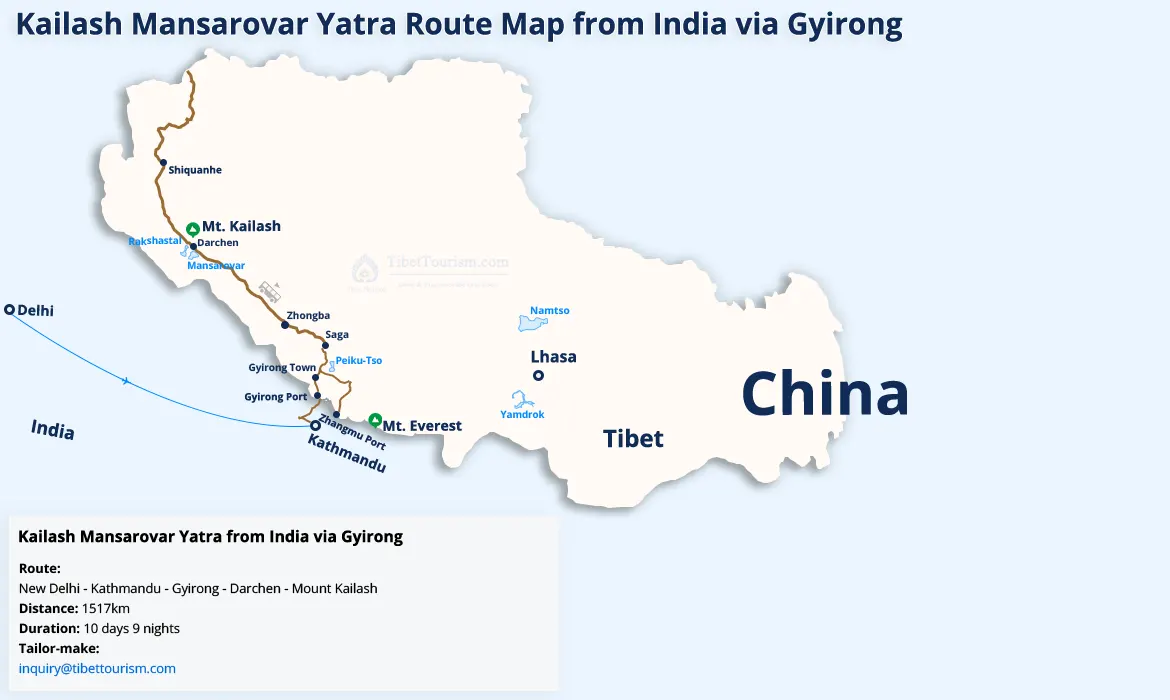 Kailash Mansarovar New Route Map from India via Gyirong
India to Kailash Parvat via Purang Port
Purang Port lies at the China-India-Nepal border, offering smooth entry into Tibet. Embarking on a 1731-kilometer yatra from New Delhi to Mount Kailash via Purang Port, the itinerary spans about seven days with an India-Nepal flight. Commencing in Kathmandu, travelers will navigate through Nepalgunj and Simikot by air, covering 366 kilometers and 208 kilometers respectively, before taking a helicopter to Hilsa, near the China-Nepal Border. After crossing the Purang Border into Tibet, you’ll stay overnight at Purang and enjoy a scenic 69-kilometer to Mansarovar Lake on the next day. After Mansarovar Parikrama, you’ll follow the final 90-kilometer overland stretch to Darchen, the base camp of Mount Kailash, which takes approximately 1 hour and 30 minutes. The estimated total cost for this India-Purang-Kailash route is around USD 2800.
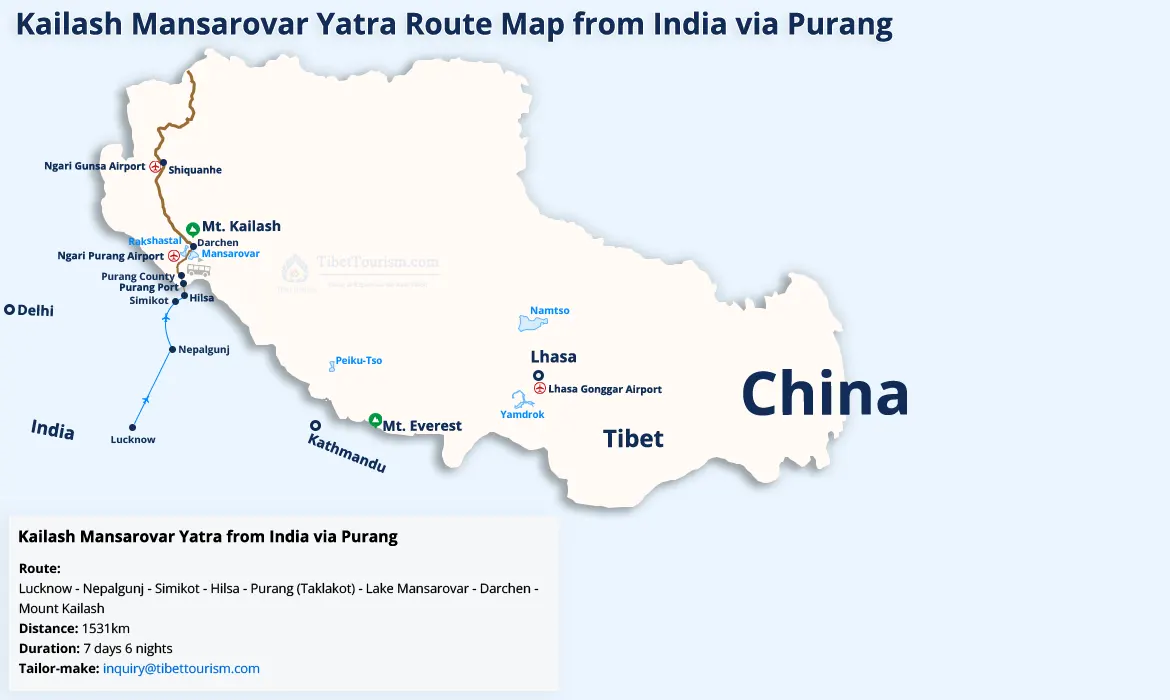 Kailash Mansarovar New Route Map from India via Purang
FAQs on Indians Go to Kailash Parvat
1. How much does it cost to go to Kailash Parvat from India?
The cost of a Mount Kailash tour from India varies significantly based on transportation modes, accommodation standards, travel month, and the duration of the trip.
Visa and permit fees are an essential part of the budget; you’ll need a Chinese Group Visa or Chinese Visa, a Tibet Travel Permit, an Aliens’ Travel Permit, and a Military Area Entry Permit. Except China Visa, the fees for the rest are typically rolled into the overall tour package price.
Transportation costs are influenced by whether you choose to travel by helicopter, flight, or road. A helicopter ride to Mount Kailash is the most expensive option, with prices around USD 3100.
Accommodation costs during the journey from India to Mount Kailash also contribute to the total expense. In cities like Kathmandu, Lhasa, Shigatse, and Darchen, luxury accommodations may exceed USD 60 per night, while guesthouses during the Kailash Kora charge about USD 15 to 20 per person per night.
Food and beverage costs are another consideration. The daily cost for food and beverages can range from USD 10 to USD 50, depending on your dining choices. Sampling local Tibetan and Nepalese cuisine can enrich your experience, often at moderate prices.
Personal expenditures such as hiring yaks or porters for luggage assistance during the trek and purchasing souvenirs like thangkas and Tibetan incense will add to the overall cost. These additional expenses can vary widely based on individual preferences and shopping habits.
In summary, the comprehensive cost for traveling from India to Mount Kailash can vary greatly. If you opt for a private tour, the costs, plus the fees of hiring guides and drivers, can amount to a high price. For a budget-friendly India to Kailash Parvat tour, consider joining a small group tour. The price is usually much lower as you can share the guide, driver, vehicle, and hotel costs with your group members. If you are interested in our Kailash Yatra small group tour from India, don't hesitate to contact us!
2. What is the best time to go to Kailash Parvat from India?
India, Nepal, and Tibet each have distinct weather patterns that significantly influence the best time to travel to Kailash Parvat from India. India experiences a tropical monsoon climate, while Nepal’s climate is characterized by significant seasonal variations, with snowfall in higher altitudes. Tibet, on the other hand, has a four-season monsoon climate with less rainfall than other monsoon regions due to the Himalayas filtering out much of the rain. Despite these variations, the optimal time to travel from India to Tibet for a Kailash Parvat tour is generally from April to October. May to June and September to early October are especially favored for clear skies and comfortable temperatures. The Saga Dawa Festival, which occurs on the 15th day of the fourth month of the Tibetan Lunar Calendar, is marked by grand religious celebrations. The full moon period is also considered particularly auspicious, as it is believed that the merit from the pilgrimage. During these periods, flows of pilgrims gather at Mount Kailash and start their Kora around the mountain. If you seek a special experience, consider aligning your travel time with religious events, ensuring a more spiritually significant Kailash journey.
3. What should we pack for Kailash Mansarovar Yatra from India?
When preparing for a yatra from India to Kailash Parvat, equipping yourself with appropriate attire for the high-altitude climate and unpredictable weather is paramount. Your wearing should include insulating down jackets, windbreakers, and thermal trousers, which are indispensable given the cold temperatures in mountain conditions, especially at night. Opt for layered clothing to facilitate quick changes according to the shifting weather. Hiking shoes or sneakers are a must for navigating the uneven landscape. Sun protection is also key, hence, sunglasses, sunscreen, and lip balm are vital additions to your pack. Among other essentials, a thermos for hot waters is invaluable for warmth in chilly climates, while a trekking pole provides much-needed support and balance on mountain paths. Carrying a small and lightweight backpack can make the parikrama easier and more convenient. Personal hygiene items like wet wipes and toilet paper are also indispensable. Medically, be prepared with medications for altitude-related ailments such as Diamox and Acetazolamide, as well as for common issues like headaches, fever, and diarrhea.
4. What is the age limit for Indians to join Kailash Mansarovar Yatra?
Joining a Kailash trip from India is not restricted by a rigid age requirement. All individuals, provided they meet the requirements for visiting Mount Kailash and possess a fundamental level of health, are welcome on this journey. With our agency’s experience in Tibet travel, we have led travelers ranging from small kids to those in their advanced years to the sacred sites of Mount Kailash and Lake Mansarovar. Nevertheless, the physical rigors of the trip should not be overlooked. The pilgrimage from India to Kailash is demanding, particularly due to the high-altitude terrain and the requirement for mountain trekking. Thus, it’s advisable that tourists maintain robust health and possess adequate physical fitness to cope with the journey’s challenges. Engaging in light aerobic exercises a few months before departure can help. This will not only reduce discomfort during the trip but also enable you to stay in optimal condition during the Kailash Yatra, allowing you to fully enjoy the stunning scenery and cultural experiences along the way.
5. What about the accommodation on Kailash Mansarovar Yatra from India?
On the Kailash Yatra from India, the choices of accommodation span from upscale hotels to basic guesthouses, depending on the route and destination. In urban hubs like Kathmandu, Lhasa, Shigatse, Darchen, Shanghai, and Beijing, an array of accommodations is available, from prestigious hotels like the Hyatt Regency Kathmandu and St. Regis Lhasa Resort to more modest options with essential bedding and facilities. In more remote sites, especially during the Mount Kailash Parikrama, options narrow to primarily guesthouses and camps. Early booking is recommended, especially during peak travel seasons and religious events, to secure a comfortable stay. Booking with us, our dedicated personnel will ensure accommodations are tailored to your preferences and standards.
6. What to eat in Kailash Mansarovar Yatra from India?
Embarking on a journey to Kailash Parvat from India presents a culinary feast that includes Indian and Nepalese cuisine, traditional Tibetan fare, Sichuan specialties, and Western fast food options. As you traverse from India to Mount Kailash, with layovers in cities like Kathmandu, Lhasa, and Darchen, you’ll find diverse gastronomic choices, from local teahouses to high-end eateries offering a spectrum of dishes, from the local butter tea and momos to more complex fare such as stone pot chicken and hot pot. On the trek around the revered Mount Kailash, food choices are more constrained, primarily consisting of teahouses and supply points that serve local staples like Tibetan noodles and tsampa. To sustain energy levels, it’s advisable to bring some snacks including bread, instant noodles, and fresh fruit when possible. For those seeking a tailored culinary journey, hiring a personal chef to prepare warm meals can enhance your Mount Kailash travel experience.
 You can enjoy lots of Tibet cuisine like Tibetan noodles during your Kailash tour
7. How to alleviate possible altitude sickness in Kailash Mansarovar Yatra from India?
When embarking on a yatra from India to Kailash Parvat, gradually acclimating to the altitude is essential to mitigate the risk of altitude sickness, enabling your body to adapt to the plateau environment. Spending a few days in Kathmandu and Lhasa helps in acclimating to the high-altitude conditions before progressing to the 4500-meter height at Mount Kailash. Ensure you get ample rest, maintain hydration, and refrain from alcohol and smoking. It’s also crucial to consume light meals and avoid doing intense physical activity during the initial period in Tibet. Mild symptoms of altitude sickness are common and often subside within 48 hours. To manage altitude sickness, consider preparing medications like Acetazolamide. If you experience severe discomfort, inform our guide immediately and consider descending to a lower altitude for relief.
Besides medication, other preventive measures include ascending slowly and maintaining a positive mental attitude, which can also support your acclimatization process. Our experienced guides will provide continuous support to ensure your safety and comfort. Taking these precautions seriously will help you enjoy a safe and healthy pilgrimage to Mount Kailash.
8. Which route is best for Kailash Mansarovar Yatra from India?
12-day Lhasa entry/exit overland tour is ideal for a relax pace and more sightseeings, which gives you time to adapt to high altitude and enjoy Tibet’s cultural landmarks before reaching Kailash. 10-day Gyirong entry/exit overland offers you a good combination of gradual acclimatization and shorter duration. It's a popular choice for those who want safety and efficiency without skipping too many scenic spots. 7-day Purang entry/exit overland tour is the quickest route, which increases the risk of altitude sickness due to the rapid ascend. It’s suitable for travelers who are already acclimated or have limited time.
For most pilgrims, the 10-day India-Gyirong-Kailash route is the best balance between safety, comfort, and time efficiency. If you have more days and want a richer cultural experience, choose the 12-day India-Lhasa-Kailash route. If you’re short on time and well-prepared for high altitude, the 7-day India-Purang-Kailash route works. You can choose the most suitable route according to your preference.
Conclusion
The yatra from India to Kailash Parvat is more than just a sightseeing journey; it is a profound spiritual quest. This sacred route is of immense significance to various religions, offering a transformative experience that fosters personal reflection and deepens one's connection with the divine. It is encouraging for tourists and pilgrims alike to know that this route is accessible. By meeting specific requirements, one can embark on a journey to the holy mountain from India. With the necessary travel documents in order, and with transportation, food, and accommodations arranged, you can set off on a lifetime adventure. This voyage, aimed at seeking spiritual enlightenment, promises a return laden with inner peace and a profound sense of fulfillment.
15 years exp.| 5.0
 | Reviews
Tell me about your travel plan or contact me via inquiry@tibettourism.com
Kailash Mansarovar Yatra Guide for Indians


Most Popular Kailash Mansarovar Yatra Packages from India

Please share your contact information, so we can send you the answer directly by email.

