
 inquiry@tibettourism.com


.webp)


Beijing to Lhasa Train


.webp) Content
ContentFor those planning a trip to Tibet via Beijing as the transit city, taking the train to Tibet can help you acclimatize to the high altitude while you can enjoy the breathtaking views of the Tibetan Plateau. This all-encompassing article provides you with detailed information about Beijing to Lhasa train route map, train schedule, train cost for each type of carriage, documents needed in the journey, and scenic highlights during the train journey, etc.
Basic Facts about Beijing to Lhasa Train
Beijing to Lhasa Train Open Date: 2006
Beijing to Lhasa Train Route: Z21
Beijing to Lhasa Train Type: Z-series
Beijing to Lhasa Train Departure Station & Time: Beijing West Railway Station (19:22)
Beijing to Lhasa Train Arrival Station & Time: Lhasa Railway Station (11:42)
Beijing to Lhasa Train Distance: 3,757 kilometers (2,334 miles)
Beijing to Lhasa Train Duration: 40 hrs 20mins
Beijing to Lhasa Train Frequency: Daily
Beijing to Lhasa Train Ticket Class & Cost: Soft Sleeper (from $161), Hard Sleeper (from $101), Hard Seat ($51)
Beijing to Lhasa Train Avg. Speed: About 92km/h
Beijing to Lhasa Train Stops: Beijing, Shijiazhuang, Taiyuan, Zhongwei, Lanzhou, Xining, Delingha, Golmud, Nagqu,
Lhasa
Beijing to Lhasa Train Highlights: Yuzhu Peak, Tanggula Mountains, Tuotuo River
Beijing to Lhasa Train Route Map
Starting in Beijing, the route heads through Hebei Province, Shanxi Province, Shaanxi Province, Ningxia Hui Autonomous Region, Gansu Province, and Qinghai Province. The train stops at several major stations in China, namely, Beijing, Shijiazhuang, Taiyuan, Zhongwei, Lanzhou, Xining, Delingha, Golmud, Nagqu, Lhasa.
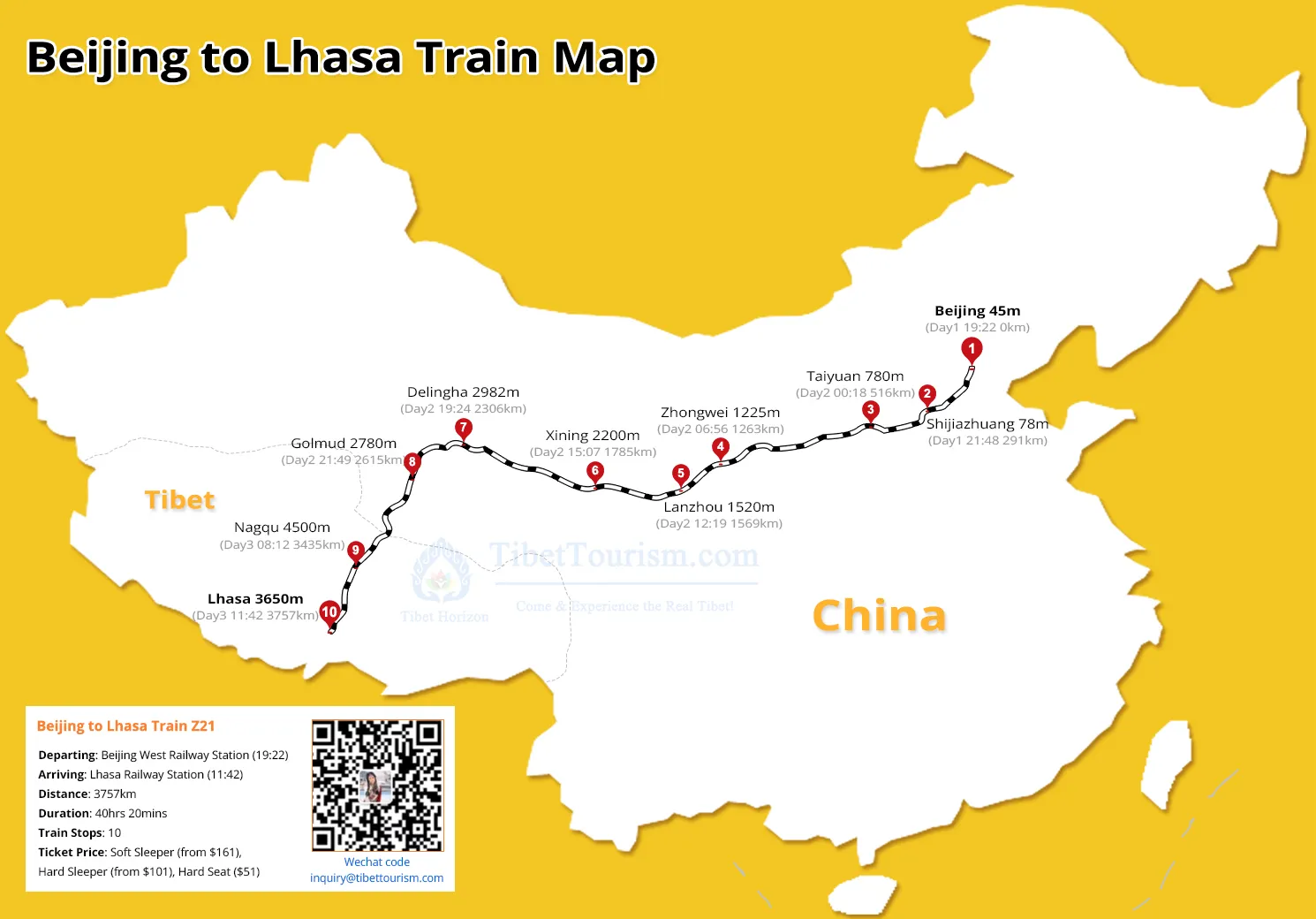 Beijing to Lhasa Train Map
Beijing to Lhasa Train Schedule: Station, Altitude, Time, and Distance
Stretching for 3,757 kilometers across most of China, this awesome route from the eastern coast to the highest capital of China is a trip that encompasses three days. During the 40 hours and 20 minutes’ journey, you will experience a rollercoaster ride especially as the Tibet train leaves Taiyuan and gradually climbs from Qinghai Provinces to lofty Tibetan Plateau. Check the major railway stations, altitude ascent and descent along the way in the following real time train schedule.
| No. | Station | Altitude | Day | Arrival | Departure | Stop Time | Distance |
|---|---|---|---|---|---|---|---|
| 1 | Beijing West | 45m | Day 1 | / | 19:22 | / | 0km |
| 2 | Shijiazhuang | 78m | Day 1 | 21:48 | 22:24 | 36 min | 291km |
| 3 | Taiyuan | 780m | Day 2 | 00:18 | 00:26 | 8 min | 516km |
| 4 | Zhongwei | 1225m | Day 2 | 06:56 | 07:16 | 20 min | 1263km |
| 5 | Lanzhou | 1520m | Day 2 | 12:19 | 12:31 | 12 min | 1569km |
| 6 | Xining | 2200m | Day 2 | 15:07 | 15:32 | 25 min | 1785km |
| 7 | Delingha | 2982m | Day 2 | 19:24 | 19:28 | 4 min | 2306km |
| 8 | Golmud | 2780m | Day 2 | 21:49 | 22:14 | 25 min | 2615km |
| 9 | Nagqu | 4500m | Day 3 | 08:12 | 08:18 | 6 min | 3435km |
| 10 | Lhasa | 3650m | Day 3 | 11:42 | / | / | 3757km |
| No. | Station | Altitude | Day | Arrival | Departure | Stop Time | Distance |
|---|---|---|---|---|---|---|---|
| 1 | Beijing West | 45m | Day 1 | / | 19:22 | / | 0km |
| 2 | Shijiazhuang | 78m | Day 1 | 21:48 | 22:24 | 36 min | 291km |
| 3 | Taiyuan | 780m | Day 2 | 00:18 | 00:26 | 8 min | 516km |
| 4 | Zhongwei | 1225m | Day 2 | 06:56 | 07:16 | 20 min | 1263km |
| 5 | Lanzhou | 1520m | Day 2 | 12:19 | 12:31 | 12 min | 1569km |
| 6 | Xining | 2200m | Day 2 | 15:07 | 15:32 | 25 min | 1785km |
| 7 | Delingha | 2982m | Day 2 | 19:24 | 19:28 | 4 min | 2306km |
| 8 | Golmud | 2780m | Day 2 | 21:49 | 22:14 | 25 min | 2615km |
| 9 | Nagqu | 4500m | Day 3 | 08:12 | 08:18 | 6 min | 3435km |
| 10 | Lhasa | 3650m | Day 3 | 11:42 | / | / | 3757km |
Beijing to Lhasa Train Ticket Class & Cost: Soft Sleeper, Hard Sleeper, Hard Seat, and Ticket Price
As the world’s highest railway with an average altitude of 4,000m, the Qinghai-Tibet Railway is an engineering marvel and a much sought-after journey for travelers heading to Tibet on the roof of the world. Traversing vast grasslands, snow-capped mountains, and permafrost regions, it offers a breathtaking journey through some of China’s most remote and stunning landscapes.
The Qinghai-Tibet Railway offers three types of carriages: soft sleeper, hard sleeper, and hard seat, each providing travelers with different levels of comfort and facilities. So, what are the price ranges of different types of Tibet train tickets? And which kind of train ticket should you choose? Read the following section to choose the ticket that suits you best.
1. Beijing to Lhasa Train Soft Sleeper
On the train from Beijing to Lhasa, there are 2 soft sleeper carriages with 18 compartments and 72 berths. There are 4 berths in each compartment, two upper and two lower. The width of berth is 75cm and the length is 190cm. They are spacious enough for tall passengers. Each compartment have plenty of luggage space respectively beneath the lower berths and beside the upper berths. There are a table, TV Screen, oxygen outlets, clothes hangers and a lockable door equipped in them. The soft sleeper ticket sells at ¥1144.0 ($161) for the upper berth and at ¥1186 ($167) for the lower berth.
2. Beijing to Lhasa Train Hard Sleeper
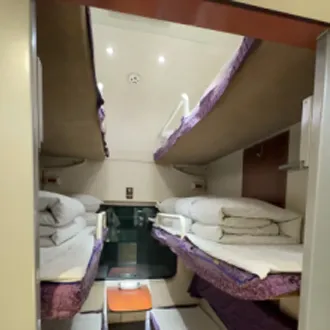
There are 8 hard sleeper carriages with 88 compartments and 528 berths. Each compartment has 6 berths, two upper, two middle and two lower. The compartment is a little crowed. The width of a berth is 60cm and the length is 180cm. So there is no door for a hard sleeper compartment, which is comfortable for most of passengers. Each compartment also has luggage space respectively beneath the lower berths and beside the upper berths. The hard sleeper tickets are priced at ¥720 ($101) for the upper berth, ¥742 ($104) for the middle berth, and ¥763 ($107) for the lower berth.
3. Beijing to Lhasa Train Hard Seat
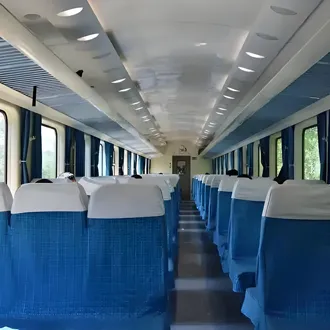
The train has 3 hard seat carriage with a total seating capacity of 354 persons. Because the distance from Beijing to Lhasa is long, the hard seat is not a good choice for travelers to Tibet. The hard seat ticket only costs you ¥360 ($51). The sacrifice you’ve made is the comfort and good sleep. So, think twice before booking hard seats.
4. Which kind of train ticket should I choose?
For the long train journey from Beijing to Lhasa, we highly suggest our clients choose the soft sleeper ticket instead of the hard sleeper or hard seat to ensure a more comfortable and safer Tibet train tour because you will need to stay two nights on the train. Or you can check the following table for your reference.
| Feature | Soft Sleeper | Hard Sleeper | Hard Seat |
|---|---|---|---|
| Beijing to Lhasa Train Z21 | 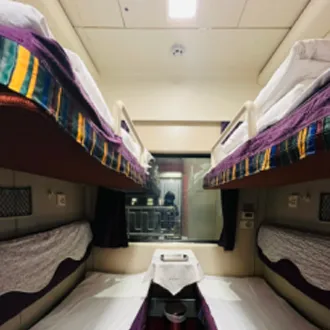 |
 |
 |
| Comfort Level | ★★★★☆ (High) | ★★★☆☆ (Medium) | ★☆☆☆☆ (Low) |
| Berths per Compartment | 4 (2 upper, 2 lower) | 6 (2 upper, 2 middle, 2 lower) | No berths (seats only) |
| Privacy | More (with door) | Less (no door) | None |
| Bed Softness | Softer mattress | Firmer mattress | No bed |
| Space | More spacious | Less spacious | Very cramped |
| Noise Level | Lower | Higher | Very high |
| Cost | Most expensive Upper Berth: $161, Lower Berth: $167 |
Moderate Upper Berth: $101, Middle Berth: $104, Lower Berth: $107 |
Cheapest Hard Seat: $51 |
| Best for | Comfortable travel | Budget travelers | Short trips or low-budget travelers |
| Feature | Soft Sleeper | Hard Sleeper | Hard Seat |
|---|---|---|---|
| Beijing to Lhasa Train Z21 | |
|
|
| Comfort Level | ★★★★☆ (High) | ★★★☆☆ (Medium) | ★☆☆☆☆ (Low) |
| Berths per Compartment | 4 (2 upper, 2 lower) | 6 (2 upper, 2 middle, 2 lower) | No berths (seats only) |
| Privacy | More (with door) | Less (no door) | None |
| Bed Softness | Softer mattress | Firmer mattress | No bed |
| Space | More spacious | Less spacious | Very cramped |
| Noise Level | Lower | Higher | Very high |
| Cost | Most expensive Upper Berth: $161, Lower Berth: $167 |
Moderate Upper Berth: $101, Middle Berth: $104, Lower Berth: $107 |
Cheapest Hard Seat: $51 |
| Best for | Comfortable travel | Budget travelers | Short trips or low-budget travelers |
About Beijing to Lhasa Train Ticket Price: The ticket prices above are the net price. The actual ticket booking price is higher with service fee included. Because Beijing to Lhasa train is one of the most favorite routes to Tibet, we suggest you to book your train ticket as soon as possible.
Beijing to Lhasa Train Ticket
Once you’ve decided to take the train to Lhasa, be sure to book Tibet train tickets as early as possible. Currently, you can book Tibet train tickets 15 days earlier before you leave for Lhasa.
1. How to book Beijing to Lhasa train ticket?
For foreigners planning to traveling to Tibet, there are three reliable ways to book a Beijing to Lhasa train ticket, i.e. through the China Railway’s official website, at the train station, and via a local Tibet travel agency like Tibet Horizon.
Booking Beijing-Lhasa train tickets through China Railway’s official website (www.12306.cn) is the most popular choice for domestic travelers. With an English version available, you need to sign up first and then verify your identify with your passport information. After choosing the right ticket, you pay through your Chinese bank account, WeChat Pay, or Alipay to secure the ticket. A great alternative is through Trip.com, where you have more payments, such as Visa, Mastercard, PayPal, Apple Pay, and more options.
You can also book the Beijing-Lhasa ticket in person at the railway station in your city, i.e. Beijing West Railway Station, which is less-chosen option nowadays for the convenience of online booking. It is worth noting that don’t expect to book Beijing to Lhasa train ticket on your departure date since it will always be sold out.
The third way, booking the ticket via a trusted Tibet travel agency, like Tibet Horzion, comes as a boon for those who want to increase the chances of securing a Beijing to Lhasa train ticket with less efforts. We can book the ticket according to your preference and budget plan.
Useful tips to purchase train ticket from Beijing to Lhasa successfully:
1.Try to contact us more than 45 days in advance and book Tibet tour with us, and control the ticket seat as soon
as possible. We will apply for your Tibet Travel Permit;
2.If you fail to get a ticket of Beijing to Lhasa train, you can change the starting station Beijing, such as
Lanzhou or Xining which offers bigger chance to get a ticket.
2. Where and how to get Beijing to Lhasa train ticket?
If you’ve book the ticket on China Railway’s official website or Trip.com, you can get an E-ticket, which together with your passport, Chinese Visa, Tibet Travel Permit is all you need to board the train at the Beijing West Railway Station.
If you’ve booked the ticket with us, we will deliver the ticket (E-ticket or printed paper ticket) to you. Then you can use your valid passport, Chinese Visa, train ticket, and Tibet Travel Permit to enter the railway station and board the train.
Notice: Once getting your train ticket, please read the ticket and double-check Your Name and Passport Number on it. If the name and passport number are not matched with your passport and Tibet Permit, you may not be allowed to board the train.
3. How to read Beijing to Lhasa train ticket?
北京西站: Beijing West Railway Station / Beijingxi
拉萨站: Lhasa Railway Station
xx年xx月xx日xx开: xx Year xx Month xx Date xx Departing
xx车xx号上/中/下铺: xx Carriage xx Upper/Middle/Lower Berth
新空调软卧/硬卧/硬座: Soft Sleeper/Hard Sleeper/Hard Seat
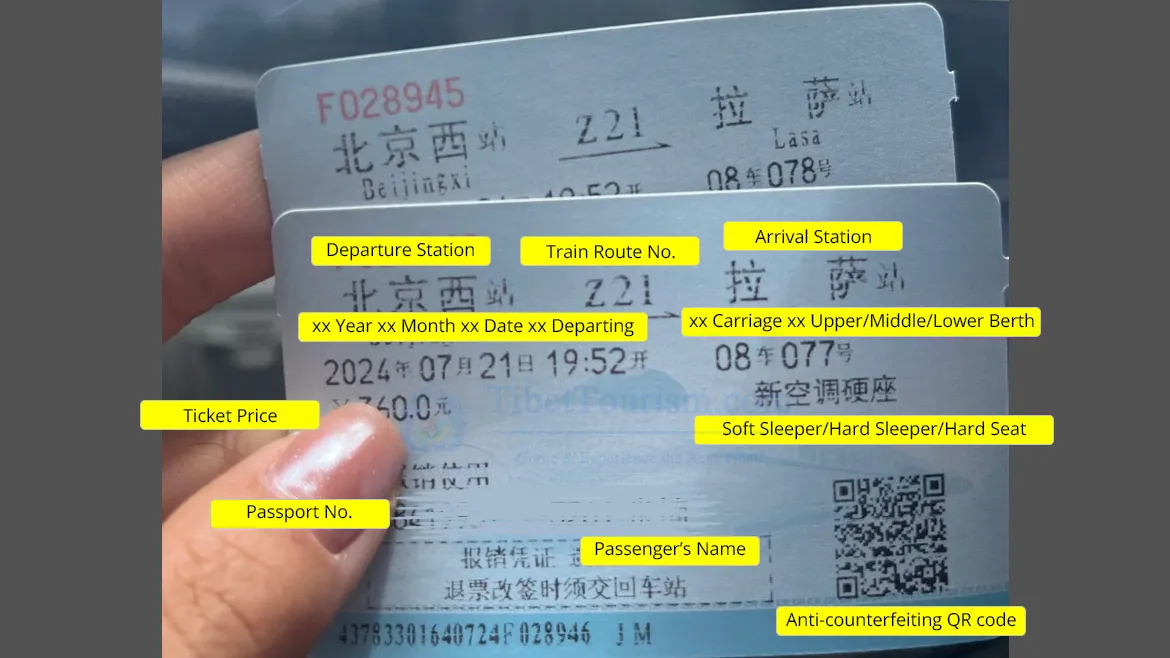 Beijing to Lhasa Train Ticket
Beijing to Lhasa Train Trip
The following questions are some of the most frequently asked ones for foreigners traveling to Tibet from Beijing by train. Read and feel free to ask us if you have further questions.
1. How to get to Beijing West Railway Station?
You can get to Beijing West Railway Station by subway or by taxi, depending on your schedule and budget. If you take the subway, board Beijing Metro Line 7 or Line 9 and get off at Beijing West Railway Station stop, which is directly connected to the station. The subway option costs you around 3-6 RMB depending on your boarding point.
If you opt for a taxi, you can simply tell the driver your destination, Beijing West Railway Station, or “Beijing Xi Zhan” in Chinese. It usually takes around 20-40 minutes from central Beijing to Beijing West Railway Station, with the fare ranging from 30 to 60 RMB.
2. What travel documents do l need for Beijing to Lhasa train?
For foreign travelers heading to Tibet, three main documents are needed. First, a valid passport. the same as the one used to apply for your visa and permits is necessary. Secondly, you need a valid Chinese Visa (L visa) that is not expiring during your trip. Last, a Tibet Travel Permit is mandatory when you pass the security check and board the train to Lhasa. The permit is issued by the Tibet Tourism Bureau and usually applied by a licensed travel agency on your behalf. Please note that you are recommended to submit related materials to your travel agency at least one month prior to your travel date.
3. How to board the train from Beijing to Lhasa Tibet?
1) Get your train ticket firstly and then pass the security check into the waiting hall of train station;
2) Fill in the health form in the waiting hall;
3) Pass the ticket checkpoint;
4) Find your train carriage according to your train ticket and the LED screen show;
5) Board the train and pass the ticket check again;
6) Find your berth according to your train ticket;
7) Change your train ticket paper to berth card. Train boarding ends.
4. What's the best time for Beijing to Tibet train tour?
The best time for a Beijing to Tibet train tour is from April to October. April, May, June, and September are ideal for the pleasant weather, clear sky and less crowd compared to the peak summer months. July and August are the peak travel season with warmer weather and live festivals. October offers cooler temperature and stunning autumn landscapes. All factors considered, April to June and September to October is best recommended for its combination of good weather, beautiful scenery and moderate crowds.
5. What to see in Beijing to Lhasa train journey?
The highlights of Beijing to Tibet train center from Golmud to Lhasa. It time you wipe the dust off your window when arriving in Golmud for you are about to enjoy a visual feast of Nagqu grasslands, snow-capped peaks and shimmering alpine lakes at sunset, etc.
Yuzhu Peak is the first major attraction after the train leaves Golmud. Standing at 6178 meters, Yuzhu Peak is one of the highest mountains in the eastern section of the Kunlun Mountains. Yuzhu Peak is a favorite among mountaineers and adventurers for its challenging yet accessible climbs. From your train window, the peak appears serene and timeless -- a symbol of the raw, untouched beauty of China's wild west.
Located at the foot of the Tanggula Mountains, the Tuotuo River is one of the main sources of Yangtze River, China’s longest and most famous river. The Tuotuo River flows through a breathtaking high-altitude landscape of wide, open grasslands and distant snow peaks, making it a perfect moment to snap some photos or simply enjoy the majestic natural beauty.
After passing the source of Yangtse River, you are about to reach the highest place of Tibetan train and the highest railway point in the world, Tanggula Mountain Pass (5072m). You are to be treated to views of towering peaks, endless stretched of permafrost, and a untouched landscape that feels otherworldly. You’ll feel like you’re touching the sky, a peaceful and dreamlike moment in the journey. Passing through Tanggula is not just a scenic highlight---it’s a moment that makes you truly feel the spirit of the Tibetan Plateau.
-
![8 Days Beijing Flight to Lhasa Shigatse Everest Base Camp Tour]()
8 Days Beijing Flight to Lhasa Shigatse Everest Base Camp Tour
Features:
Best choice for China exploration
Explore diverse landscapes and cultures
Face the majestic Mt. EverestGroup size: Min.1 pax
Tour price: free enquire >
-
![11 Days Beijing Xian, Qinghai-Tibet Train to Lhasa and Shanghai Tour]()
11 Days Beijing Xian, Qinghai-Tibet Train to Lhasa and Shanghai Tour
Features:
Ultimate China tour with Tibet
Best choice forfirst-timers in China
Diverse landscapes and city vibesGroup size: Min.1 pax
Tour price: free enquire >


6. How about Beijing to Lhasa train facilities?
Spending two days on a Beijing-Lhasa train adds a unique flavor to your Tibet journey, for you can experience the real engineering wonder running on lofty Tibetan Plateau. The train is equipped with tourist-friendly facilities and cutting-edge technology that ensure a safe and comfortable ride all the way to holy Lhasa.
In addition to the sleeping cabins mentioned above, the train also offers food and drinks. You can either buy boxed meal or snacks from the trolley that comes through the carriages, or order formal dishes in the dining carriage where professional chef will make mostly traditional food for you. The meal costs around 25-50 RMB for each person. You can also buy some snacks or fruit before you board the train to kill the leisurely time when enjoying the stunning views outside the window. In addition, hot water dispensers are also equipped, providing boiling water for you to make tea, coffee or instant noodles.
The train is also equipped with basic toilets and washing facilities, including Chinese and Western-style toilets, and shared washbasins. Toiletries and tissues are not supplied, so bring enough amount of them.
As the Beijing to Lhasa train leaves Golmud, extra oxygen will be released pervasively in the carriages to help passengers adapt to the high altitude. Special oxygen outlets are available near each seat and bed in case some passengers still have shortness of breath.
7. What shall l be aware of on Beijing to Lhasa train ride?
First, always carry your passport and Tibet Travel Permit with you, since you’ll need them to board the train and for inspections along the way. Additionally, high altitude reaction is an issue that can never be escaped for people heading to Tibet. But don’t worry, mild symptoms like headache, dizziness, or shortness of breath are normal and can disappear in two days. You can alleviate the symptoms by drinking plenty of water, avoiding alcohol intake, and using oxygen supply if needed.
8. How to get to Lhasa City from Lhasa Train Station?
Your guide will pick you up at Lhasa Railway Station and transfer you to your hotel in downtown Lhasa. It usually takes about 20 minutes from Lhasa Railway Station to downtown Lhasa. On the way to your hotel, you have the chance to view the Yarlung Tsangpo River, the longest and largest river in Tibet. After arriving at the hotel, your tour guide will help you check in. You can take some time to rest and get prepared for your upcoming trip in Lhasa.
9. How to shorten Beijing to Lhasa train travel time?
If you cannot get your Beijing-Lhasa train ticket or are deterred by the 40-hour journey on the train, we suggest you adopt a blend of train and flight transportation. You could firstly fly from Beijing to Xining and then board the Xining-Lhasa train to Lhasa, with the later train journey taking around 20 hours. This way, you can both cut the long journey in half and enjoy the highlights of the journey along the Qinghai-Tibet Railway.
10 years exp.| 5.0
 | Reviews
Tell me about your travel plan or contact me via inquiry@tibettourism.com
Tibet Train Travel Guide and Advice


Please share your contact information, so we can send you the answer directly by email.
-

Mr. Ga-Young from South Korea, asked on April 6th, 2025
is it Possible to Get off the Train for Local Sightseeing
Is it possible to get off the train on a defined station for local sightseeing and continue the next day by train?

Mr. Karma from Tibet Horizon, answered on April 6th, 2025
Dear Ga-Young, Thanks for your inquiry. Sorry, it is not possible to do this with the same ticket since it has a fixed seat or berth number tied to your specific train and travel date. Your ticket becomes invalid once you get off the train.
If you want to do the sightseeing en route, you need to buy separate tickets for each leg of your journey, which is tricky. So we don’t recommend you drop off halfway.

