
 inquiry@tibettourism.com


.webp)


How to Do Kailash Mansarovar Yatra? Top 4 Kailash Parikrama Routes for Indians


.webp) Content
ContentMount Kailash is considered one of the most sacred mountains in the world and is a pilgrimage destination for followers of Hinduism, Buddhism, Jainism, and Bon. Since Mount Kailash is located in Tibet, China, the immigration regulations of China make this pilgrimage journey full of challenges. The journey to this spiritual summit varies for each pilgrim, with distinct paths and procedures tailored to their nationality and status. Compared to citizens of other countries, the way for Indian believers to go on a pilgrimage is more complicated. This article will detail the documents needed for Indian passport holders and Indians with foreign nationalities to go to Kailash in Tibet, best time to visit Kailash, recommended Kailash Parikrama route, and other suggestions to help you better plan this pilgrimage yatra to Kailash Parvat.
 Mount Kailash
1. China Visa and Tibet Travel Permit for Indians to Do Kailash Mansarovar Yatra
For Indians who want to go to Mount Kailash, whether you are citizens with Indian passports or Indians with foreign nationalities, you need to follow specific regulations to handle the corresponding documents and procedures, but there are some differences between the two, which we will introduce in detail next:
For Indian passport holders traveling to Tibet
For Indian passport holders traveling to Tibet, there are usually two types of tourists: one is Indian pilgrims who come to Tibet mainly to worship around Mount Kailash and Lake Mansarovar, and the other is ordinary India citizens who travel around Lhasa and its surrounding areas like other foreign tourists. For these two different types of Indian tourists, the way to organize Tibet tour is different.
Indian pilgrims who go to Kailash Parvat:
Every May, the Ngari area of Tibet begins the pilgrimage season. Individual pilgrims are prohibited from going to Tibet's Mount Kailash and Lake Mansarovar. Hindu believers who want to go to Mount Kailash for a parikrama must sign up and participate in a special pilgrimage group organized by the Foreign Affairs Office of TAR and Tibet-India Pilgrim Reception Center, obtaining a Tibet Travel Permit (Tibet Pilgrimage Permit) jointly reviewed and issued by the Tibet Autonomous Region Foreign Affairs Office, Tibet Military Region, Tibet Border Defense Armed Police Force, and Tibet Public Security Department. Currently, only two institutions can authorize Indian pilgrimage groups to go to Kailash Tibet, one is the Tibet Autonomous Region Foreign Affairs Office, and the other is the Pilgrimage Reception Center.
Here are the specific application steps, which can provide you with some reference:
Step one: Hindus who want to worship Gang Rinpoche in Tibet first register for the annual Mount
Kailash and Lake
Mansarovar pilgrimage.
Step two: All pilgrims shall submit the following documents 25 days before entry: Health
examination report,
issued within 6 months by Indian public hospital higher than district level. Content of the report should
include doctor’s judgment and suggestion whether the pilgrim’s physical condition is suitable for the plateau
areas (4000 meters or 13,000 feet above sea level). Pilgrims suffering from high blood pressure, heart disease,
asthma and other diseases which are not suitable for entering plateau areas cannot apply the permit. The age of
the passport shall prevail. In the year of pilgrimage to X.A.R., pilgrims aged 70 and above are not allowed to
apply for entry permits.
Step three: The Tibet Pilgrimage Reception Center will receive the pilgrimage group at the Tibet
border port and
assist during the pilgrimage.
Warm reminder:
1. All Indian pilgrimage groups will only be received by the Tibet Foreign Affairs Office and the Tibet-India
Pilgrimage Reception Center, and other domestic travel agencies that are not authorized cannot receive
pilgrimage groups. As a partner with Pilgrim Center, Tibet Horizon can arrange your Kailash Mansarovar Yatra from India
and help you apply for an Aliens' Travel Permit and Military Area Entry Permit
together.
2. In addition, you will need to apply for a Chinese Visa if you are entering Tibet from Chinese Mainland, or a
Chinese Group Visa if you are entering via Nepal.
Ordinary Indian tourists who don’t go to Kailash Parvat:
Chinese Visa: All foreign tourists, including Indian citizens, must apply for a Chinese Visa to travel to China. You can apply for a Chinese Visa at the Chinese embassy in India, and it is recommended that you apply about a month in advance. When you enter Tibet, the staff at the Chinese port of entry will check whether your passport and Chinese visa are valid. (If you are entering Tibet from Kathmandu, you need to apply for a Chinese Group Visa in India)
Tibet Travel Permit: If you are an ordinary passport holder of Indian nationality traveling to Tibet and do not plan to go to non-open areas such as Ngari, you only need to send us a copy of your passport and Chinese Visa. We can handle the Tibet Travel Permit for you according to your information. Before you take a plane or train, we will deliver the Tibet Travel Permit to you to help you start your journey to Tibet smoothly. This type of tourist only needs to participate in the Tibet tour organized by a regular Tibet travel agency like Tibet Horizon.
For Indians with foreign nationalities traveling to Tibet
For Indian-origin tourists of other nationalities who want to go to Mount Kailash and Lake Mansarovar, they only need to obtain ordinary documents such as Chinese Visa/Chinese Group Visa, Tibet Travel Permit, Aliens’ Travel Permit, and Military Area Entry Permit like other ordinary foreign tourists. Even if you go to Mount Kailash for a pilgrimage, you will not be considered a pilgrim. You can choose our popular itineraries in Kailash tour or let us customize a special Tibet trip for you.
2. Kailash Parikrama: Top 4 Kailash Parikrama Routes for Indians
The Mount Kailash pilgrimage routes pass through mountains, lakes, and mountain passes, and each route carries different cultural significance and challenges. Although all routes center around Mount Kailash, they have different starting points, degrees of difficulty, and scenery. We will have four routes for you to choose from.
Three-day Kailash Outer Parikrama (Kailash Outer Kora)
The Mount Kailash Yatra usually refers to the outer parikrama around Mount Kailash, which generally takes three days. The first day of hiking starts from Darchen to Dirapuk Monastery, passing through the Prayer Square (Tarboche), Two Legs Pagoda (Yam Dwar) and Qugu Temple, about 20 kilometers, with an altitude increase of 200 meters, taking about 10 hours. The second day of hiking will go from Dirapuk Monastery to Zutul puk Monastery, taking about 14 hours to cover 18 kilometers, and then reach the highest altitude point of this hike, Dolma La Mountain Pass. The third day of hiking will go from Zutul puk Monastery back to the starting point of the pilgrimage, Darchen. This is the common three-day outer kora hiking itinerary. For tourists who want to participate in this itinerary, we have 12-day , 8-day , and 9-day Kailash Mansarovar Yatra group tours available for you to choose from, which includes your adaptation and sightseeing period in Lhasa as well as the road/flight trip time to travel to Mount Kailash from Lhasa.
 Kailash Kora Map
Four-day Kailash Outer Parikrama with Charan Sparsh
If you want to make your trip more meaningful, you can add an extra day. Based on the original three-day kora, add a trip to the north slope of Mount Kailash on the second day. You will start from Dirapuk Monastery and hike 6 kilometers to the north slope of Mount Kailash, where you have the opportunity to touch the hard rock wall of the sacred mountain (Charan Sparsh), and then return to Dirapuk Monastery for a stay. If you want to explore the mystery and beauty of Tibet more comprehensively, we recommend you to join our 16-day Saga Dawa Festival Kailash touching group tour to experience the yatra path of Gang Rinpoche more deeply and feel the Tibetan culture.
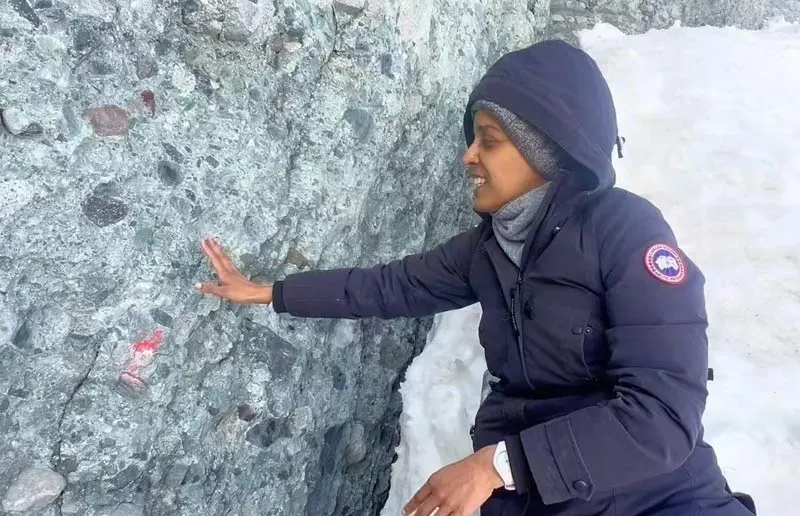 Touch the hard rock wall of the sacred Mountain Kailash (Charan Sparsh)
Kailash Outer Parikrama plus Dakini Secret Path (Khado Sanglam)
Local Tibetans and sincere pilgrims, after completing the outer circle 13 times, start the 14th circle of the parikrama to the Dakini Secret Path: Darchen - Dirapuk Monastery - Sky-burial Site - Dolma La Pass - Gauri Kund (Cibei Lake) - Budong Diding - Entrance/Exit of Dakini Secret Path - Khado Sanglam Pass - Entrance/Exit. After several rounds of pilgrimage at the Dakini Secret Path, they continue to Zutulpuk Monastery and eventually return to Darchen. This route is more dangerous and difficult than the other three and more physically demanding for you.
One-day Kailash Inner Parikrama (Kailash Inner Kora)
The inner parikrama also starts from Darchen, passing through Selung Temple, and as the altitude continues to rise, it finally passes through Yinjietuo Mountain (Nandi Parvat) to reach Thirteen Golden Pagodas. According to legend, Nandi Parvat (Mt. Yinjietuo) is the guardian mountain of the sacred Mount Kailash, and you can also regard the inner kora as circling Nandi Parvat. Although the inner circuit is only about 26 kilometers, half the distance of the outer circuit, the inner circuit road is more complex, and even the road cannot be identified after snowfall. You can walk a pilgrimage around the Thirteen Golden Pagodas, cross the Yinjiento/Nandi Pass, and return to Seraung Monastery up to Darchen by following the road on the right side of the valley. Since there are fewer visitors in the inner circuit, and no supply and rest points like the outer circuit, you need to return to Darchen before dark. If you want to choose the inner circuit pilgrimage, you generally start at 4 am and return to Darchen around 6 pm.
Each Mount Kailash Yatra route represents different challenges and experiences. You can choose the path suitable for you according to your needs, physical strength, and beliefs. These routes are not only a test of the body but also a profound spiritual journey, where you integrate with nature, faith, and ego, completing the purification and sublimation of the soul. No matter which route you choose, circumambulating Mount Kailash is an unparalleled spiritual pilgrimage.
3. Highlights in Kailash Mansarovar Yatra
In addition to Kailash Parvat, there are several sacred and unique attractions along the yatra route that pilgrims should not miss when completing this spiritual journey. These places not only have profound religious and cultural significance but are also full of magnificent natural landscapes.
Lake Mansarovar: Lake Mansarovar is considered one of the most sacred lakes in the world and is the holy lake of Mount Kailash. For Hindus, it has a very high religious status. You can stop by the lake for prayers. Surrounded by snow-capped mountains, the water is clear and transparent and the scenery is picturesque. This place is not only an important spiritual landmark on the pilgrimage route but also a place for the soul to find peace during the pilgrimage.
Dolma La Pass: It is the highest point of the Mount Kailash outer circuit pilgrimage, with an altitude of about 5650 meters, and is also the most challenging part of the entire pilgrimage route. This mountain pass symbolizes the process of pilgrims overcoming difficulties and accepting the test of the gods.
North Slope of Kailash Parbat (Charan Sparsh): The north slope of Mount Kailash is one of the most sacred places, and many pilgrims believe that the north slope is the closest place to the sacred mountain. During this journey, you can circumambulate the north side of Mount Kailash for worship and prayer.
Dirapuk and Zutulpuk Monasteries: Two important monasteries, located on the outer yatra route, offer spiritual solace and shelter to pilgrims and provide insight into Tibetan Buddhist practices and local culture.
Thirteen Golden Pagodas: Located on the inner kora route, these pagodas are believed to mark a sacred boundary protecting Mount Kailash.
4. How to Start a Kailash Mansarovar Yatra from India? Two Routes to Kailash Parvat from India
How to go to Mount Kailash from India? Indians traveling to Mount Kailash usually need to transit through Kathmandu, Nepal, or other cities in Chinese Mainland.
India - Other cities in China - Tibet
You can fly from India to popular tourist cities in China, such as Shanghai, Beijing, Guangzhou, Chengdu, etc. However, there are no direct flights from India to Chinese Mainland and you need to transit through places like Bangkok, Singapore, etc. Upon arrival, you can extend your journey to popular tourist destinations in China. In this way, you can not only enrich your travel experience but also flexibly choose the departure city for Tibet, whether you choose convenient air travel or experience train travel to enjoy the scenery along the Qinghai-Tibet Railway.
Here we just take Chengfu for example. As the capital of Sichuan Province, Chengdu is known for its rich culture, delicious cuisine, and giant pandas, making it a worthwhile stopover. It not only has the frequent flights to Tibet but also the direct train to Lhasa. Qinghai-Tibet Railway, the world’s highest altitude railway, offers you the stunning views of the Tibetan Plateau, snow-capped mountains, and vast grasslands. The train is equipped with oxygen supplies to help you gradually acclimate to the high altitude.
India - Kathmandu, Nepal - Tibet
Nepal is located to the south of Tibet, China, and is an ideal transit point for traveling from India to Tibet. There are direct flights every day from places like Delhi and Mumbai in India to Kathmandu, the capital of Nepal. After arriving in Kathmandu, you can choose to travel to Tibet by plane or by road. There are direct flights from Kathmandu to Lhasa every Monday, Wednesday, and Friday. If you prefer road travel, you can also go to Kailash from Kathmandu via Gyirong Port or Purang Port. Moreover, the Kailash Yatra route via Kathmandu offers a unique cultural experience, allowing you to explore Nepal’s rich heritage, cuisine, and historic sites such as Boudhanath Stupa and Pashupatinath Temple before continuing your pilgrimage.
5. Best Time to Visit Kailash Parvat from India: April to October
The best time for the Mount Kailash Yatra is between April and October each year. The climate in Tibet during this period is mild and dry, suitable for long outdoor hikes. The daytime temperature is usually between 15℃ and 25℃. Although the temperature difference between morning and evening is large, it is generally suitable for high-altitude long-distance hiking. The weather in Mount Kailash during the summer and autumn seasons is stable, with less precipitation and relatively less wind, providing the best hiking environment. At the same time, the grassland during this period is the most lush, and the scenery along the way is the most charming. Belows are the monthly weather in Kailash Mansarovar area:
April and May mark the beginning of the pilgrimage season when the snow starts to melt, revealing clear paths and blooming alpine flowers. The air is fresh, and the landscapes are vibrant with spring colors.
June to August is the warmest period, ideal for those who prefer milder temperatures. However, travelers should be prepared for occasional afternoon showers. This season coincides with the Saga Dawa Festival, a significant religious event attracting many pilgrims.
September and October offer crisp, clear skies and cool temperatures, perfect for trekking. The autumn colors on the Tibetan Plateau create breathtaking views, and the fewer tourists make for a more peaceful pilgrimage experience.
6. How to Join a Kailash Mansarovar Yatra Package? Do Kailash Mansarovar Yatra with Tibet Horizon
If you plan to go to Mount Kailash for a pilgrimage, choosing a professional travel platform will provide comprehensive protection and support for your journey. As an experienced travel agency, Tibet Horizon can provide you with customized yatra services. Whether it is handling documents, arranging itineraries, or providing professional guides and high-altitude adaptation support, Tibet Horizon can ensure that your yatra to Kailash Parvat is safe and fulfilling.
22 years exp.| 5.0
 | Reviews
Tell me about your travel plan or contact me via inquiry@tibettourism.com
Kailash Mansarovar Yatra Guide for Indians


Most Popular Kailash Mansarovar Yatra Packages from India

Please share your contact information, so we can send you the answer directly by email.
-

Mr. Sharma from India, asked on June 24th, 2025
Has anyone climbed Mount Kailash?
Who climbed Kailash Parvat?

Mr. Tsering Wangdue from Tibet Horizon, answered on June 25th, 2025
Dear Sharma, thank you for extending you questions to us!
Has anyone climbed Mount Kailash? This is one of the most frequently asked questions by our clients. In fact, no one has ever climbed Mount Kailash. According to Buddhist legend, Milarepa, one of Tibet's most famous yogis and spiritual poets, is said to be the only person who ever ascended Mount Kailash, but there is no historical record showing that he actually reached the summit. In Hinduism, Mount Kailash is regarded as the abode of Lord Shiva and is considered sacred and inviolable. Additionally, the government of China has never issued any climbing permits for Mount Kailash. Today, climbing Mount Kailash is strictly prohibited. If you have any further questions about Kailash Parvat or Mount Kailash trip, feel free to contact us.

