
 inquiry@tibettourism.com











Sacred Tibetan Symbols: The 8 Auspicious Signs & Their Meanings


 Content
The Eight Auspicious Symbols—known in Sanskrit as Ashtamangala—are sacred motifs widely recognized in Tibetan Buddhism and Himalayan art. They represent blessings, wisdom, protection, prosperity, and spiritual enlightenment. Rooted in ancient Indian religious and cultural traditions, these symbols were later incorporated into Buddhist teachings and artistic practices. Today, these symbols are widely seen in Tibetan monasteries, thangka paintings, prayer flags, and traditional decorations.
The following table introduces the eight auspicious symbols, their Sanskrit and Tibetan names, and their main spiritual meanings.
| Symbol | Sanskrit Name | Tibetan Name | Core Meaning |
|---|---|---|---|
| Parasol | Chattra | Rinchen Dug | Protection and spiritual shelter |
| Two Golden Fish | Suvarnamatsya | Sergyi Nya | Freedom and liberation |
| Treasure Vase | Kalasha | Terbum | Abundance and prosperity |
| Lotus Flower | Padma | Pema | Purity and enlightenment |
| White Conch Shell | Shankha | Dungkar Yekhyil | The spread of Buddhist teachings |
| Endless Knot | Shrivatsa | Palbeu | Interdependence and wisdom |
| Victory Banner | Dhvaja | Gyaltsen | Triumph over ignorance |
| Dharma Wheel | Dharmachakra | Khorlo | Dharma and the Eightfold Path |
The Eight Auspicious Symbols and Their Meanings
The Eight Auspicious Symbols, or Ashtamangala, each represent a distinct aspect of Tibetan Buddhist teachings, including good fortune, protection, wisdom, and the path to enlightenment.
1) The Parasol (Chattra / Rinchen Dug): Protection and Spiritual Shelter
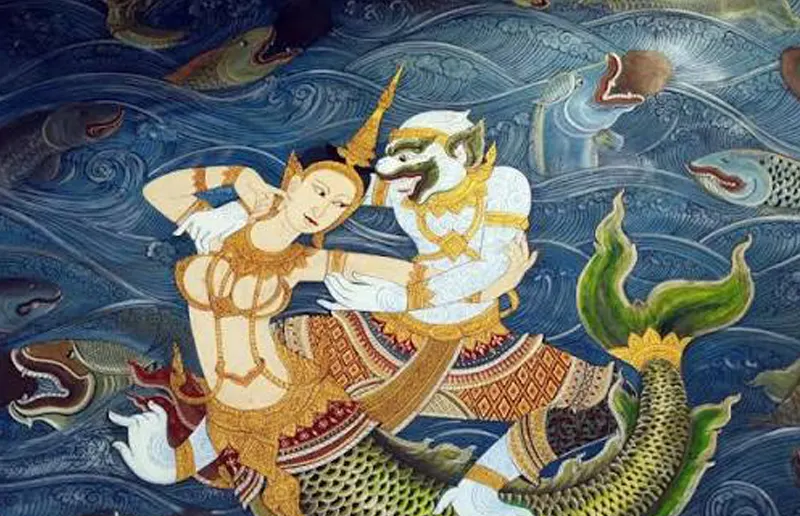
The parasol is traditionally depicted as an ornate canopy with a decorated handle and hanging silk ornaments. In ancient India, it was a symbol of royalty and high status, providing shade and protection from the sun. In Tibetan Buddhism, the parasol symbolizes protection from suffering, illness, and spiritual obstacles, just as it provides shade from the sun.
 The Parasol
2) The Two Golden Fish (Suvarnamatsya / Sergyi Nya): Freedom and Liberation
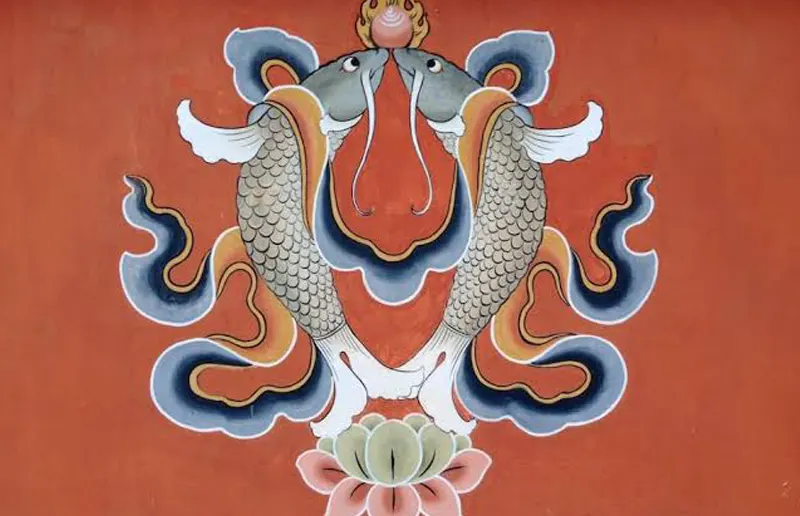
The two golden fish are usually depicted swimming side by side, often with their heads facing opposite directions. Their free movement through water symbolizes fearlessness, happiness, and freedom. In Tibetan Buddhism, they represent liberation from the ocean of samsara, the cycle of birth, death, and rebirth.
 The Two Golden Fish
3) The Treasure Vase (Kalasha / Terbum): Abundance and Prosperity
The treasure vase is a decorative vessel with a rounded body, narrow neck, and jeweled lid. It is traditionally associated with inexhaustible riches and sacred substances. In Tibetan Buddhism, it symbolizes material prosperity, spiritual wealth, longevity, and good fortune. It also represents the spiritual benefits of the Buddha's teachings and the potential for spiritual growth.
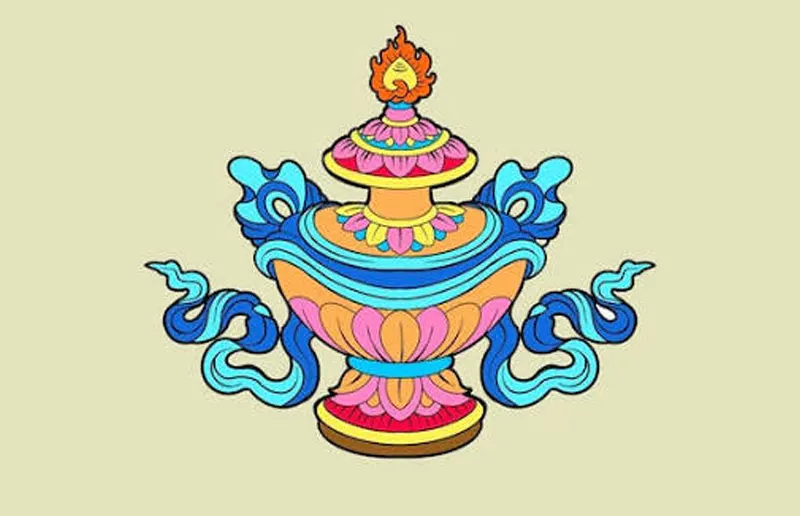 The Treasure Vase
4) The Lotus Flower (Padma / Pema): Purity and Enlightenment
The lotus grows in muddy water but rises above the surface to bloom into a beautiful, unstained flower. This contrast makes it a classic symbol of spiritual awakening and moral purity. In Tibetan Buddhism, the lotus represents the purity of body, speech, and mind. It also symbolizes the path to enlightenment through the development of wisdom and compassion.
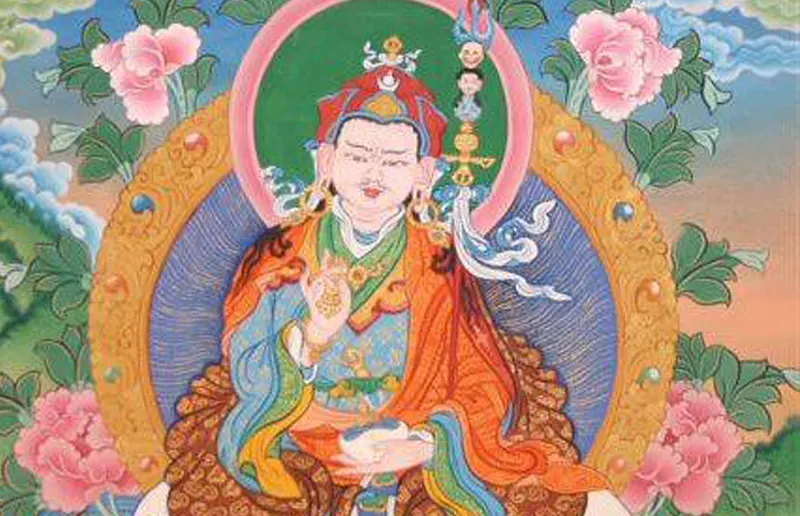 The Lotus Flower
5) The Right-Turning White Conch Shell (Shankha): The Sound of Dharma
The white conch is traditionally depicted with a right-turning spiral. It was historically used as a ceremonial horn to produce a powerful, far-reaching sound. In Tibetan Buddhism, the conch symbolizes the spread of the Dharma. Its powerful sound represents the Buddha's teachings, awakening people from ignorance and encouraging them to cultivate wisdom and compassion.
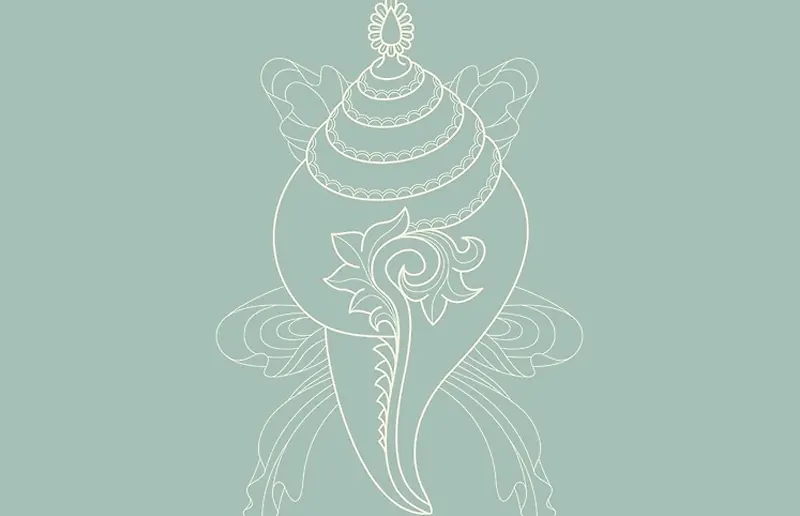 The Right-Turning White Conch Shell
6) The Endless Knot (Palbeu): Interdependence and Wisdom
The endless knot features an intricate pattern of interwoven lines with no visible beginning or end. Its continuous loop reflects the interconnectedness of all phenomena, symbolizing interdependence, karma, and the union of wisdom and compassion. It also reminds people that their actions have consequences, reflecting the Buddhist principle of karma.
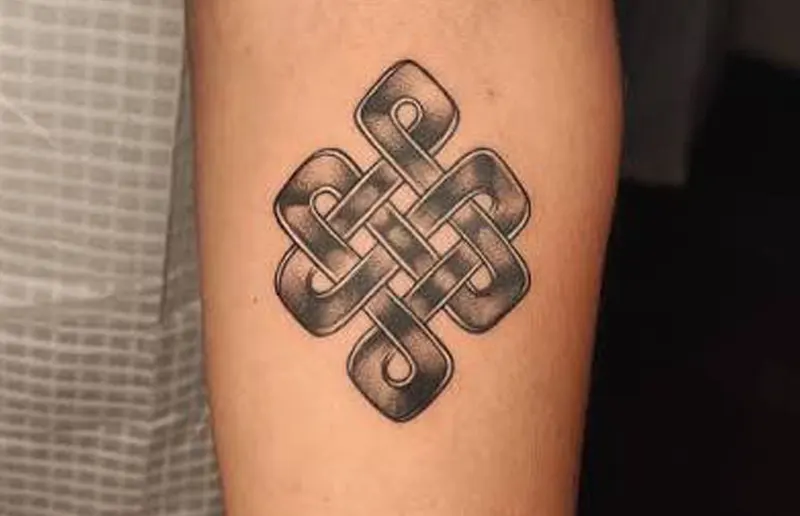 The Endless Knot
7) The Victory Banner (Dhvaja / Gyaltsen): Triumph over Ignorance
The victory banner is traditionally depicted as a tall, decorated structure with a cylindrical or tiered shape. In ancient India, banners were used to celebrate victory and represent authority. In Tibetan Buddhism, it symbolizes the triumph of wisdom over ignorance and negative emotions. It is also associated with overcoming the four Maras, which represent forces that obstruct spiritual progress.
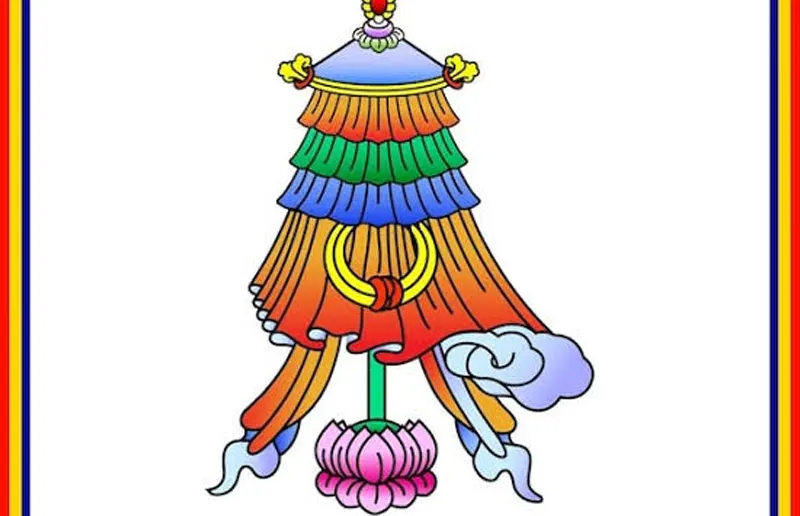 The Victory Banner
8) The Dharma Wheel (Dharmachakra): The Buddha's Teachings and the Eightfold Path
The Dharma Wheel is usually depicted with eight spokes connecting its center to the outer rim. It represents the Buddha's teachings and the continuous spread of the Dharma. Its eight spokes symbolize the Noble Eightfold Path: Right View, Right Intention, Right Speech, Right Action, Right Livelihood, Right Effort, Right Mindfulness, and Right Concentration. Together, these principles guide Buddhists in developing wisdom, ethical conduct, and mental discipline.
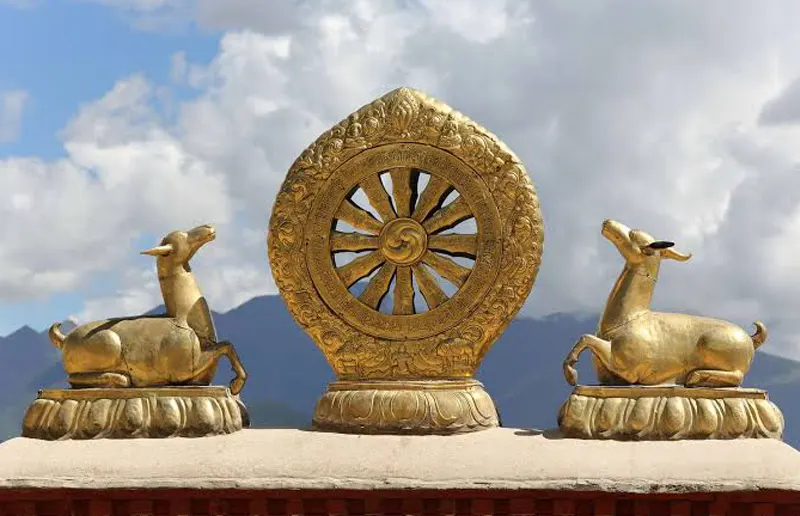 The Dharma Wheel
Cultural Significance of the Eight Auspicious Symbols in Tibet
Beyond their spiritual meanings, the Eight Auspicious Symbols remain an important part of Tibetan religious and cultural life.
1) Tibetan Buddhist Symbols in Monasteries and Architecture
The Eight Auspicious Symbols are common decorative elements in Tibetan monasteries and religious buildings. They can be found on monastery walls, entrances, pillars, rooftops, and altars. Some monasteries display all eight symbols together, while others feature individual motifs in different locations. The Dharma Wheel, often displayed between two deer on monastery rooftops, is a particularly recognizable Buddhist motif.
2) The Eight Auspicious Symbols in Tibetan Art and Handicrafts
The Eight Auspicious Symbols are widely used in Tibetan art and traditional handicrafts. They appear in thangka paintings, prayer flags, carpets, wooden furniture, metalwork, and decorative textiles. Artists often combine the symbols with lotus patterns, clouds, and other Buddhist motifs. Each motif combines decorative appeal with a distinct spiritual meaning.
3) The Eight Auspicious Symbols in Tibetan Festivals and Rituals
The Eight Auspicious Symbols also play a role in Tibetan religious ceremonies and celebrations. During the Tibetan New Year (Losar), auspicious decorations are used to welcome blessings, happiness, and prosperity for the coming year. During certain ceremonies, the symbols are drawn on the ground with colored powder or flour to invite good fortune. They may also be used in wedding decorations and other special celebrations to express wishes for happiness and prosperity.
4) Wearing and Displaying Auspicious Symbols in Daily Life
Many Tibetans incorporate auspicious symbols into jewelry, amulets, prayer wheels, and household decorations. Pendants and rings featuring the lotus, endless knot, or other Buddhist motifs are popular examples. Prayer wheels may also feature these designs alongside Buddhist mantras. For visitors, these items offer a way to appreciate Tibetan religious art and craftsmanship. When buying or displaying religious objects, treat them with respect by avoiding placing them on the floor, stepping over them, or using them inappropriately.
Where to See Tibetan Buddhist Symbols in Tibet
Tibetan Buddhist symbols can be found throughout Tibet, from historic temples and monasteries to traditional markets and local handicraft shops. These locations offer opportunities to explore Tibetan Buddhist art and discover how sacred symbols are used in local culture.
1) Potala Palace and Jokhang Temple in Lhasa
The Potala Palace and Jokhang Temple are two of the best places to discover Tibetan Buddhist art and symbols. At the Potala Palace, you can see Buddhist murals, religious paintings, sculptures, and decorative motifs throughout its halls and chapels. At Jokhang Temple, you can explore its sacred religious objects, traditional decorations, and important Buddhist artworks. Both landmarks are highlights of a Lhasa tour and offer valuable insights into Tibetan Buddhist culture.
2) Tibetan Monasteries and Prayer Flags
Tibetan monasteries offer opportunities to observe the Eight Auspicious Symbols in their original religious settings. Monasteries such as Sera and Drepung feature Buddhist murals, statues, wall decorations, and other sacred artwork. Prayer flags bearing Buddhist symbols and mantras can also be seen around monasteries, mountain passes, and pilgrimage routes.
3) Traditional Tibetan Markets and Handicraft Shops
Traditional markets and handicraft shops offer another way to explore Tibetan Buddhist symbols. Along Barkhor Street in Lhasa, you can find thangka paintings, prayer wheels, jewelry, wooden carvings, and textiles decorated with auspicious motifs. These items showcase traditional Tibetan craftsmanship and make meaningful cultural souvenirs.
FAQs about the Eight Auspicious Symbols of Tibetan Buddhism
1) What does the number 8 represent in Buddhism?
The number 8 is closely associated with the Noble Eightfold Path, which guides Buddhists toward liberation from
suffering and enlightenment. Its eight principles are Right View, Right Intention, Right Speech, Right Action,
Right Livelihood, Right Effort, Right Mindfulness, and Right Concentration. In Buddhist traditions, 8 is also
considered an auspicious number, associated with balance, harmony, and spiritual progress.
2) What is the most important of the eight auspicious symbols?
All eight symbols are important in Tibetan Buddhism, and none is universally regarded as the most important. Each
represents a different aspect of Buddhist teachings, including purity, protection, wisdom, prosperity, and
liberation. The Dharma Wheel is particularly significant because it represents the Buddha's teachings, while the
Lotus Flower symbolizes purity and enlightenment.
3) How are the eight auspicious symbols arranged together?
The Eight Auspicious Symbols are often displayed together as a decorative set, with each representing a different
blessing. Their positions and order may vary depending on the artistic style and regional tradition. They
commonly appear together in Tibetan thangka paintings, monastery decorations, wall carvings, and religious
textiles.
4) Are the eight auspicious symbols unique to Tibetan Buddhism?
No. The Eight Auspicious Symbols originated in ancient Indian religious traditions and became important in
various Buddhist schools. They are widely recognized in Tibetan Buddhism and also appear in Chinese Buddhism,
Nepalese Buddhist traditions, and other Himalayan Buddhist cultures. Their artistic styles and interpretations
vary across regions, although they share common spiritual themes.
5) Can non-Buddhists wear or display Tibetan Buddhist symbols?
Yes. Non-Buddhists can wear or display Tibetan Buddhist symbols as expressions of cultural appreciation or
personal interest. Common choices include jewelry and decorative items featuring auspicious motifs. Although
non-Buddhists can wear or display these symbols, they should treat them respectfully and avoid placing them on
the floor or stepping over them.
6) Do you need Buddhist knowledge to understand the eight auspicious symbols in Tibet?
No. You do not need prior Buddhist knowledge to appreciate the Eight Auspicious Symbols when traveling in Tibet.
Their basic meanings can be understood through their designs and cultural explanations. Visiting monasteries,
viewing thangka paintings, and listening to local guides can help you learn more about these symbols and their
place in Tibetan culture.
Conclusion
The Eight Auspicious Symbols offer insight into Tibetan Buddhism and its teachings on wisdom, compassion, protection, and enlightenment. These symbols continue to reflect the spiritual values and cultural heritage of Tibetan communities. Exploring these symbols during a Tibet tour offers you a deeper appreciation of the region's Buddhist traditions and cultural heritage.
2 years exp.| 5.0
 | Reviews
Tell me about your travel plan or contact me via inquiry@tibettourism.com
Related Tibet Travel Guide and Advice
Most Popular Tibet Tour Packages
-
![Lhasa Shigatse Mount Everest Small Group Tour]() Small Group Tour
8 Days Lhasa Shigatse Mount Everest Small Group Tour
Promo: Once-in-a-lifetime chance to face the tallest mountain in the world
Dates & Price
![rili]()
![xiala]()
-
![Kathmandu to Lhasa Overland Small Group Tour with EBC]() Small Group Tour
8 Days Kathmandu to Lhasa Overland Small Group Tour with EBC
Promo: Drive Across Himalaya Overland Tour with altitude rising slowly
Dates & Price
![rili]()
![xiala]()
-
![Lhasa Everest Kailash Mansarovar Zhangmu Kathmandu Small Group Tour]() Small Group Tour
12 Days Lhasa Everest Kailash Mansarovar Zhangmu Kathmandu Small Group Tour
Promo: Uncover the spiritual and natural secrets hidden within Tibet
Dates & Price
![rili]()
![xiala]()





Please share your contact information, so we can send you the answer directly by email.

