
 inquiry@tibettourism.com


.webp)


How Did Mount Everest Get Its Name?


.webp) Content
ContentThe world’s highest mountain has three names. In Tibetan, it is called Qomolangma. In Nepali, it is known as Sagarmatha. In English, it is called Mount Everest.
Standing at 8,848.86 meters (29,031.7 feet) above sea level, this single peak marks the border between China and Nepal. Its summit pierces the jet stream, its slopes are covered in ancient ice, and its very existence has drawn explorers, climbers, and pilgrims for generations. But why does one mountain have three different names? And where did the name “Everest” actually come from?
Behind this iconic peak lies a naming story that spans languages, cultures, and centuries. It is a story of local traditions passed down through generations, of global exploration, of a mathematician’s quiet calculation. Even today, the question of what to call the world’s highest point remains a subject of quiet debate.
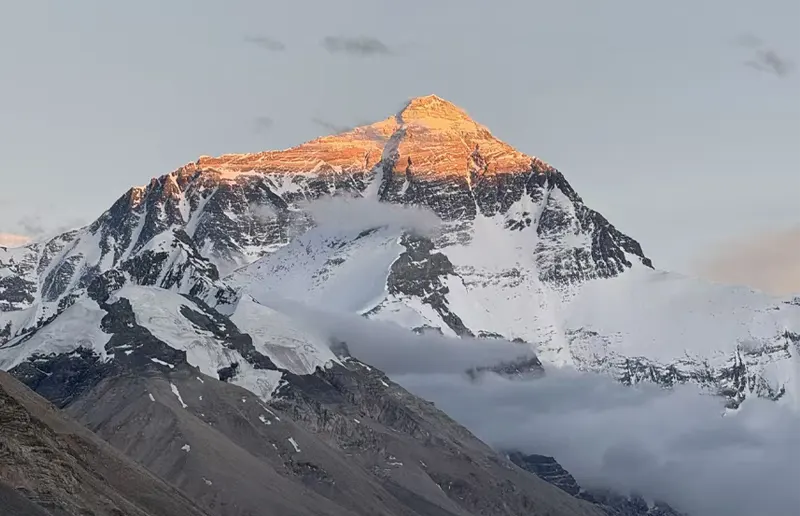 Mount Everest
Tibetan and Nepali Names: Centuries of Local Tradition
Long before any European laid eyes on this mountain, the people living on both sides of the Himalayas already had their own names for it.
The Tibetan Name of Everest: Qomolangma
In the Tibetan language, “Qomo” means “Goddess” or “Holy Mother”, and “Langma” means “Earth” or “World”. Together, Qomolangma translates to “Goddess Mother of the World” or “Holy Mother Earth”. For centuries, Tibetan people have regarded this mountain as sacred. The name reflects their deep spiritual connection to the land—a reverence that has been passed down through generations.
The Tibetan name is not a recent invention. As early as 1717, during China’s Qing Dynasty, government surveyors were sent to map the region. They recorded the local Tibetan name “Qomolangma” (which they interpreted as “Mother of Waters”) on the maps they produced.
A few years later, in 1733, French geographer Jean-Baptiste Bourguignon d'Anville published a map of Tibet based on these Qing surveys. On his map, he marked the peak as “Tchoumour Lancma M.”—an early European transcription of the Tibetan name. This shows that the local name was known in Europe long before the British "discovered" the mountain.
The Nepali Name of Everest: Sagarmatha
Many tourists may wonder what is the local name for Mount Everest in Nepal. In Nepal, the mountain is called Sagarmatha. In the Nepali language, “Sagar” means “Sky” and “Matha” means “Forehead” or “Goddess”. Together, the Nepali name means “Goddess of the Sky” or “Forehead of the Heavens”. Like the Tibetan name, Sagarmatha carries deep cultural and spiritual meaning. It reflects the reverence that Nepali people have for this towering peak, which dominates their northern horizon.
The Western “Discovery”: From Peak XV to the World’s Highest Mountain
In the mid-19th century, the British were systematically mapping India and the surrounding regions. This massive project was called the Great Trigonometrical Survey of India. Its goal was to measure the subcontinent with scientific precision, including the towering peaks of the Himalayas.
The survey was an enormous undertaking. It took decades of work, covering thousands of miles, and involved hundreds of surveyors. But the Himalayas presented a special challenge—the peaks were distant, the terrain was rugged, and the weather was unpredictable. The surveyors used theodolites—precision instruments for measuring angles—to calculate the heights of distant peaks from observation points on the plains of India and Nepal. It was painstaking work, but it would eventually reveal the true height of the world's highest mountains. In 1849, surveyors working on the project first observed this particular peak from a distance of over 200 kilometers. At the time, it was simply recorded as “Peak XV”—the fifteenth peak measured in that part of the Himalayas.
Then, in 1852, a significant discovery was made. Radhanath Sikdar, an Indian mathematician and surveyor working for the British, analyzed the data and calculated that Peak XV was actually the highest mountain in the world. His calculation gave a height of 29,002 feet—approximately 8,840 meters. This was a remarkable achievement for the time, achieved with surprisingly simple tools. Sikdar’s calculation meant that this previously anonymous peak had just become the most famous mountain on Earth. But it still had no official name.
The Official Naming: Mount Everest
In 1856, the British officially announced that Peak XV was the world’s highest mountain. The announcement caused a sensation—and raised an immediate question: what should this mountain be called? Andrew Waugh, the British Surveyor General of India at the time, faced a naming problem. The mountain straddled the border between Nepal and Tibet, and the two sides had different local names. Waugh also noted that neither Nepal nor Tibet was open to foreigners at the time, making it difficult to verify which local name was the most widely used.
After much considerations, Waugh decided to name the mountain after his predecessor—Sir George Everest, the British surveyor who had served as Surveyor General of India from 1830 to 1843. Everest had laid the foundation for the Great Trigonometrical Survey and had made significant contributions to mapping the region. Waugh thought thought it appropriate to name the mountain after this man who had initiated the survey in the first place and Everest’s name would never be forgotten.
Here is the most interesting part of the story: Sir George Everest himself opposed the naming. He argued that the mountain already had local names and that one of them should be used instead. He also pointed out that his surname was difficult to pronounce in Indian languages.
Despite his objections, the name “Mount Everest” was officially adopted by the Royal Geographical Society in 1856 and has been used internationally ever since. So, the name of this lofty peak finally change to “Everest”.
A Naming Controversy That Continues Today
The modern name “Everest” has always been a subject of debate—particularly among those who argue that the mountain’s original, local names should be used instead.
China officially adopted the Tibetan name “Qomolangma” (written in Chinese as 珠穆朗玛峰) after the 1950s. All official Chinese maps and documents use this name. In 2002, China’s state-run newspaper People’s Daily published an article arguing that the international community should respect the local name and use “Qomolangma”.
Nepal uses “Sagarmatha” for the mountain. This is the official name in all Nepali government records and documents.
Despite this, "Mount Everest" remains the most widely recognized name in English. In the mountaineering community, there is an informal consensus: respect all names, use them as appropriate, and remember that the mountain is bigger than any single name.
Make a Conclusion
Whatever you choose to call it—Qomolangma, Sagarmatha, or Mount Everest—this mountain stands tall at 8,848.86 meters (29,031.7 feet). It is the highest point on Earth, a sacred place for millions of people, and a destination that draws adventurers and pilgrims from around the globe. Today, all three names are used and respected in different contexts. And the mountain itself—whatever you call it—remains an awe-inspiring presence.
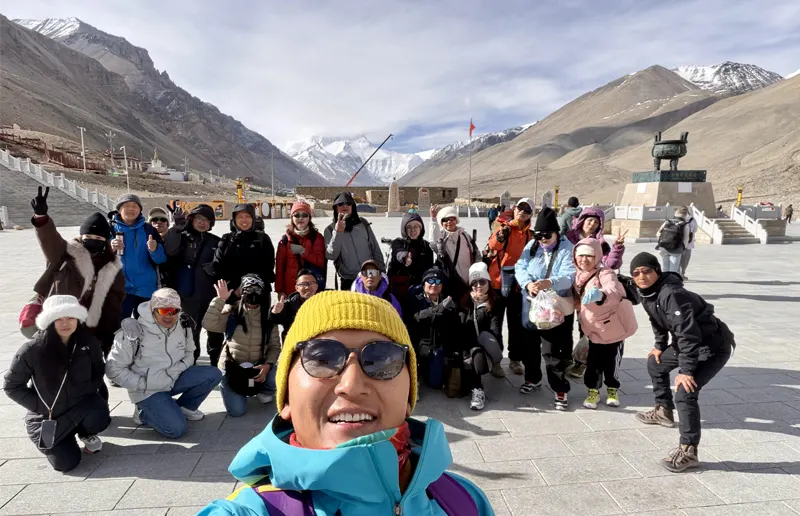 Mount Everest Tour
Plan Your Own Everest Adventure
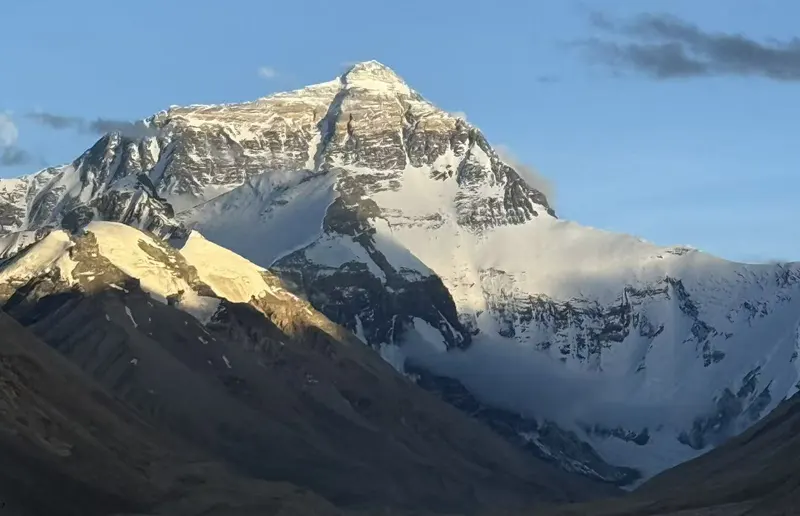
Now that you know the story behind its name, why not see it for yourself? Our Everest Base Camp tours bring you to the foot of the world's highest mountain. You’ll stand in the shadow of this legendary peak, witness sunrise paint its north face in shades of gold, and experience the awe that has drawn travelers to this region for generations. Our recommended Mt. Everest tours:
8 Days Lhasa Shigatse Mount Everest Small Group Tour
This well-paced loop gives you the full Everest experience without feeling rushed. Start in Lhasa, then roll
westward through the Tibetan countryside, stopping at the sacred Yamdrok Lake and the ancient Tashilhunpo
Monastery. Arrive at Everest Base Camp in time to watch the sun slip behind the world’s highest peak. It's the
classic route for a reason—and it never disappoints.
9 Days Lhasa Shigatse Everest Base Camp Namtso Small Group Tour
Two icons, one tour. First, you will pay your respects at Everest Base Camp from the holy city of Lhasa, watching
the north face of the world’s highest peak catch the morning light. Then, on the return leg, you will detour to
the sacred Namtso Lake—a vast expanse of turquoise water ringed by snowy peaks. It is a route that pairs the
world's most famous mountain with one of its most beautiful lakes.
7 Days Lhasa Everest Base Camp Kathmandu Overland Small Group Tour
This one-way adventure takes you from the heart of Tibet to the streets of Kathmandu, with Mount Everest as the
centerpiece. After soaking in Lhasa’s spiritual atmosphere, head overland to the base of the world’s tallest
mountain. Then keep going—cross the Himalayan passes into Nepal. It’s a journey that keeps delivering surprises,
right up to the final hilltop view of Kathmandu Valley.
12 Days Lhasa Everest Kailash Mansarovar Gyirong/Zhangmu Kathmandu Small Group Tour
This is the one for the bucket-list seekers. Yes, you will see Everest—up close and personal. But that is just
the beginning. The real heart of this journey lies further west: the sacred Mount Kailash and Lake Manasarovar,
where pilgrims have walked for millennia. Three days of circumambulation, followed by a cross-border finish in
Nepal. It is demanding, profound, and absolutely unforgettable.
Note: Since Gyirong Port was damaged by a mudslide in August 2026, it is better to travel back to Lhasa and fly to Kathmandu or your next destination.
10 years exp.| 5.0
 | Reviews
Tell me about your travel plan or contact me via inquiry@tibettourism.com
Tibet Shigatse Travel Guide and Advice


Most Popular Tibet Tour Packages
-
![Lhasa Everest Base Camp Kathmandu Overland Small Group Tour]() Small Group Tour
Small Group Tour7 Days Lhasa Everest Base Camp Kathmandu Overland Small Group Tour
Promo: Classic overland travel route from Lhasa to Kathmandu via Gyirong / Nyalam
Dates & Price
![rili]()
![xiala]()
-
![Lhasa Shigatse Mount Everest Small Group Tour]() Small Group Tour
Small Group Tour8 Days Lhasa Shigatse Mount Everest Small Group Tour
Promo: Once-in-a-lifetime chance to face the tallest mountain in the world
Dates & Price
![rili]()
![xiala]()
-
![Kathmandu to Lhasa Overland Small Group Tour with EBC]() Small Group Tour
Small Group Tour8 Days Kathmandu to Lhasa Overland Small Group Tour with EBC
Promo: Drive Across Himalaya Overland Tour with altitude rising slowly
Dates & Price
![rili]()
![xiala]()


.webp)


Please share your contact information, so we can send you the answer directly by email.

