
 inquiry@tibettourism.com


.webp)


Bhutan to Kailash Mansarovar Route Map: Detailed Guide & Itinerary


.webp) Content
ContentFor many travelers, a Kailash Mansarovar Yatra is far more than just a common journey across the Himalaya; it is a spiritual odyssey that blends breathtaking natural scenery, Tibetan Buddhist culture, and the profound pilgrimage. While there are numerous routes for reaching Kailash, Bhutan stands out as one of the most popular departure points. To better plan your Bhutan to Kailash tour, this passage offers a comprehensive guide to the most popular routes.
Can You Travel from Bhutan to Mount Kailash?
YES! You can travel from Bhutan to visit Mount Kailash. However, despite the geographical proximity between Bhutan and Tibet, there is currently no direct route connecting the two regions. For international travelers, there are two primary ways to reach Kailash and Mansarovar from Bhutan: entering via Kathmandu, Nepal, or flying from a Chinese Mainland city to Lhasa before continuing to Kailash.
Kailash Mansarovar Yatra Route & Pathway from Bhutan via Kathmandu
For pilgrims traveling from Bhutan to Kailash and Mansarovar, the most popular and convenient route involves transiting through Kathmandu, the capital of Nepal. This choice not only enables you to complete a comprehensive Kailash pilgrimage within a limited time but also offers the opportunity to immerse yourself in the unique charms of three distinct regions - Bhutan, Nepal, and Tibet in a single journey. The map below clearly illustrates the route from Bhutan to Mount Kailash via Kathmandu.
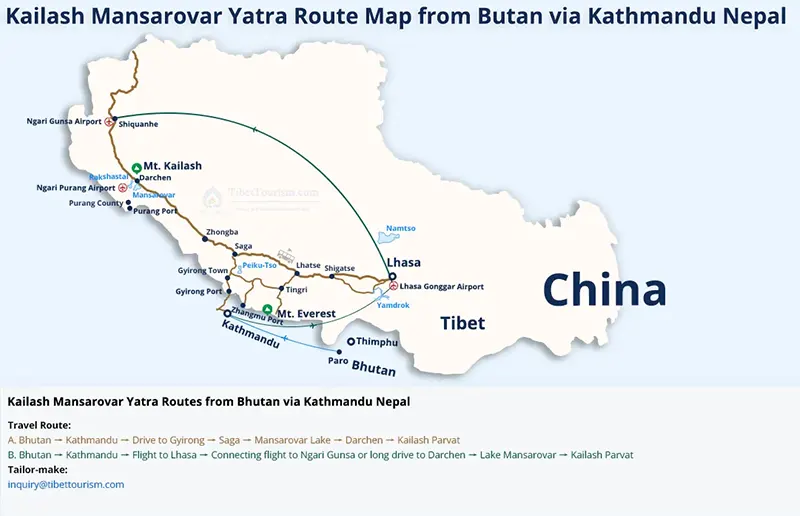 Kailash Mansarovar Yatra Route Map from Bhutan via Kathmandu
Route One: Paro - Kathmandu - Gyirong - Mount Kailash
Among all available routes from Bhutan to Kailash Mansarovar, this path is the most time-efficient option, allowing you to complete your pilgrimage with minimal time commitment and at the lowest possible cost.
Travel Route: Paro - By Flight - Kathmandu - By Overland - Gyirong - Mount Kailash
Phase 1: Fly from Paro to Kathmandu
The first phase of the journey begins at Paro Airport in Bhutan, followed by a 1.5-hour flight to Kathmandu. Although this flight is relatively short, it serves as a crucial connection between Bhutan and Kailash within your entire pilgrimage.
Upon arriving in Kathmandu, the journey officially transitions into the preparation phase. This city serves as Nepal's cultural hub and a vital gateway to Tibet and the Ngari Prefecture.
Phase 2: Kathmandu to the Gyirong Border by Overland
Departing from Kathmandu, you will travel overland toward the northern reach of the Himalayas, eventually reaching the Nepalese border - Syabrubesi. After a short walk, you will reach the Gyirong Border - China’s border checkpoint. During this process, you will complete the necessary exit formalities for Nepal and entry formalities for China, thereby officially stepping into the Tibet Autonomous Region. Upon entering Tibet, you will feel a distinct increase in altitude; however, there is no need to worry, as the itinerary typically includes overnight stays in Gyirong and Saga, providing ample time for your acclimation.
Phase 3: From Gyirong to Kailash and Return to Kathmandu
The third phase constitutes the core highlights of the entire itinerary. Upon crossing the border into Tibet, you will traverse the vast Tibet Plateau. The scenery throughout this leg of the journey undergoes a dramatic transformation: from the lush, verdant valleys of Gyirong, the landscape gradually shifts to reveal the pristine lakes and majestic snow-capped peaks, before finally arriving at Darchen to commence your Kailash Mansarovar Yatra.
Once you have completed the Kailash Kora, you will retrace your steps past the various scenic sites along the route, exit via the Gyirong Border, and return to Kathmandu.
Why Choose This Route?
The primary advantage of this route lies in its relatively short duration, making it an ideal choice for travelers with limited time. Compared to other methods to Tibet, combining flight and overland travel effectively reduces transit time, allowing for a more compact and efficient itinerary. At the same time, this route does not compromise the quality of the travel experience. On the contrary, your stopover in Kathmandu provides ample opportunity to explore Nepal's culture and urban landscape. Consequently, this route strikes a perfect balance between time efficiency and the distinct culture and scenery on both sides of the Himalaya.
Route Two: Paro - Kathmandu - Lhasa - Mount Kailash
In addition to taking you through Bhutan, Nepal, and Ngari Prefecture, this route also extends into the spiritual and cultural heart of Tibet - Lhasa.
Travel Route: Paro - By Flight - Kathmandu - By Flight - Lhasa - Mount Kailash
Phase 1: Fly from Paro to Kathmandu
As with other itineraries from Bhutan to Tibet via Nepal, the first step of your journey is flying from Paro to Kathmandu. Before embarking on the next stage of your trip, you will have the opportunity to explore the vibrant city of Kathmandu.
Phase 2: Fly from Kathmandu to Lhasa
The second phase of your journey marks a shift in pace as you continue traveling by air - flying from Kathmandu to Lhasa, where your Tibet tour officially begins. During your stay, you will take time to acclimatize to the altitude while in the profound atmosphere of Tibetan Buddhism. Potala Palace, Jokhang Temple, Barkhor Street, and Sera Monastery are among the unmissable attractions.
Phase 3: Lhasa to Kailash and Mansarovar by Overland
Departing from Lhasa, you will not head directly to Mount Kailash. Instead, you will advance your journey by following a classic itinerary, balancing high-altitude sightseeing with acclimatization. The first half of the trip takes you via Yamdrok Lake and Shigatse to Mount Everest. You will spend an unforgettable night at the foot of the world's highest peak, with the silence of the plateau and beneath the Milky Way, experiencing the magnificence and awe-inspiring of Everest up close. On the second day, accompanied by the sunrise over Everest, you will continue to the second half of your journey. As you draw closer to Ngari Prefecture, the surrounding landscape will gradually become vast and desolate, until you finally arrive at Kailash to begin your sacred pilgrimage.
Phase 4: Kailash to Kathmandu via Gyirong Border
Upon completing the Kailash Parikrama, your journey enters the return phase. You will depart Tibet via the Gyirong Border, where you have the option to return to Kathmandu to continue your unfinished exploration.
Why Choose This Route?
Compared to directly from Gyirong to Kailash Parvat, this route offers a more relaxed pace for your Kailash Mansarovar tour, resulting in a richer and more complete travel experience. Not only will you explore the profound history of Lhasa, but by gradually moving westward, you can also appreciate the allure of Tibet's many natural landscapes. By the time you finally arrive at Kailash, your body will be fully acclimatized, allowing you to focus more intently on the pilgrimage.
Kailash Mansarovar Yatra Route & Pathway from Bhutan via Chinese Mainland
In addition to traveling via Nepal, taking a route through a Chinese Mainland city on your way from Bhutan to Kailash Mansarovar can be a viable option. It is recommended that you primarily choose cities such as Chengdu, Chongqing, Kunming, etc. You can check the map below to get a general overview of the route.
 Kailash Mansarovar Yatra Route Map from Bhutan via Chinese Mainland
Bhutan - Chinese Mainland (Chengdu, Chongqing, etc) - Lhasa - Kailash Parvat
Cities such as Chengdu and Chongqing all offer direct flights to Lhasa. Additionally, you can choose from a variety of other transportation options to reach Tibet.
Travel Route: Bhutan - Flight - Chinese Mainland - Flight/Train/Overland - Lhasa - Kailash Parvat
Phase 1: Fly from Bhutan to a Chinese Mainland City
Currently, there are no direct flights from Bhutan to major Chinese cities; you typically need to fly to a third country, such as Bangkok, for a layover. This transit journey can often take up to a full day.
Phase 2: Fly from Chinese Mainland to Lhasa
Upon arriving in the Chinese Mainland, you may choose to set aside a few days to experience the vibrancy of urban life. When traveling to Lhasa, you have a variety of transportation options: Chengdu, Chongqing, and Kunming all offer well-established flight routes to Lhasa. In addition to flying, you may opt to take the Tibet train; as the altitude gradually rises, you can admire the ever-changing highland landscapes along the way, adding a richer dimension to your Kailash pilgrimage tour. Finally, if you have a passion for overland travel, you can choose to depart from Chengdu and follow National Highway G318, traversing towering mountains and deep gorges to reach Lhasa.
Phase 3: From Lhasa to Kailash Parvat
When you arrive in Lhasa, you have two options: you can choose the classic overland route, traveling gradually through the scenic landscapes of Tibet to Mount Kailash to complete the sacred pilgrimage. Alternatively, you may fly directly to Ngari Gunsa Airport; choosing this option significantly reduces your overland travel time, allowing you to reach Kailash Parvat more quickly. However, flying entails a rapid ascent in altitude over a very short period. If you are not in strong physical condition, this route is not recommended.
Why Choose This Route?
This route allows you to combine your Kailash Mansarovar tour with a sightseeing tour of Chinese cities. Although the journey may take longer than usual, the wide array of convenient transportation options available ensures that you can still reach Kailash successfully.
Conclusion
Overall, there is a wide range of route options from Bhutan to Mount Kailash, with different itineraries offering distinct travel experiences. However, among the many possibilities, the most popular and convenient method remains the route via Nepal. Regardless of which route you choose, with proper planning, you will enjoy a fulfilling Kailash Parvat tour.
3 years exp.| 5.0
 | Reviews
Tell me about your travel plan or contact me via inquiry@tibettourism.com
Bhutan to Tibet Kailash Travel Guide & Advice


Most Popular Bhutan to Kailash Tour Packages

Please share your contact information, so we can send you the answer directly by email.

